
In this article
Melanotan II is not afamelanotide, and a Melanotan II pen is not the Scenesse medical implant. Similar names and a shared connection with pigmentation can make these products look interchangeable in Bali searches. The distinction is important: evidence or authorization for one exact medicine does not transfer to another molecule or presentation.
Melanotan II vs afamelanotide: the useful comparison
| Question | Melanotan II | Afamelanotide in Scenesse |
|---|---|---|
| Name to identify | Melanotan II, also written Melanotan 2 | Afamelanotide, the active substance in Scenesse |
| Product discussed here | A labelled 20 mg pen | A specific medicinal implant |
| Why it appears in searches | Pigmentation and tanning discussions | Treatment of a defined photosensitivity disorder |
| Can the other product's approval be borrowed? | No | Approval concerns the actual medicine and indication |
The European Medicines Agency's Scenesse assessment describes afamelanotide for prevention of phototoxicity in adults with erythropoietic protoporphyria, or EPP. That is a particular medical condition and a particular product, not a general endorsement of products sold for tanning.
Why the medical indication changes the question
EPP is the context of the authorization discussed by EMA. Replacing that context with “getting a tan before a Bali holiday” changes the clinical question. The original medicine's evidence cannot simply be reworded as proof of a different cosmetic goal.
This is an example of an approval-transfer mistake: a reader recognizes a related name, sees that a medicine exists and assumes the offered product inherits its evidence. The correct comparison keeps the active substance, presentation, manufacturer documentation and intended indication together.
The same care applies to the word “implant”. It describes a specific presentation in the Scenesse information. It does not make a separately offered pen an equivalent delivery system, and the quantity on either label is not an equivalence factor.
What “melanotan” on a webpage does not tell you
The broad name alone does not specify whether a page is discussing Melanotan II, afamelanotide, a marketed spray or another presentation. Read the full ingredient name rather than relying on a short heading. This matters particularly when a seller's explanation links to a study about a different product.
The Australian Therapeutic Goods Administration warns about health risks from tanning products containing melanotan and their unapproved tanning use in Australia. That warning is relevant safety context. It is not a determination of Indonesian registration, and it should not be rewritten as one.
If a product description uses “approved”, ask: approved product, by which regulator, for which indication, and does the supplied item match it? A recognizable molecule name is not enough to answer those questions.
Read the Bali listing for what it actually contains
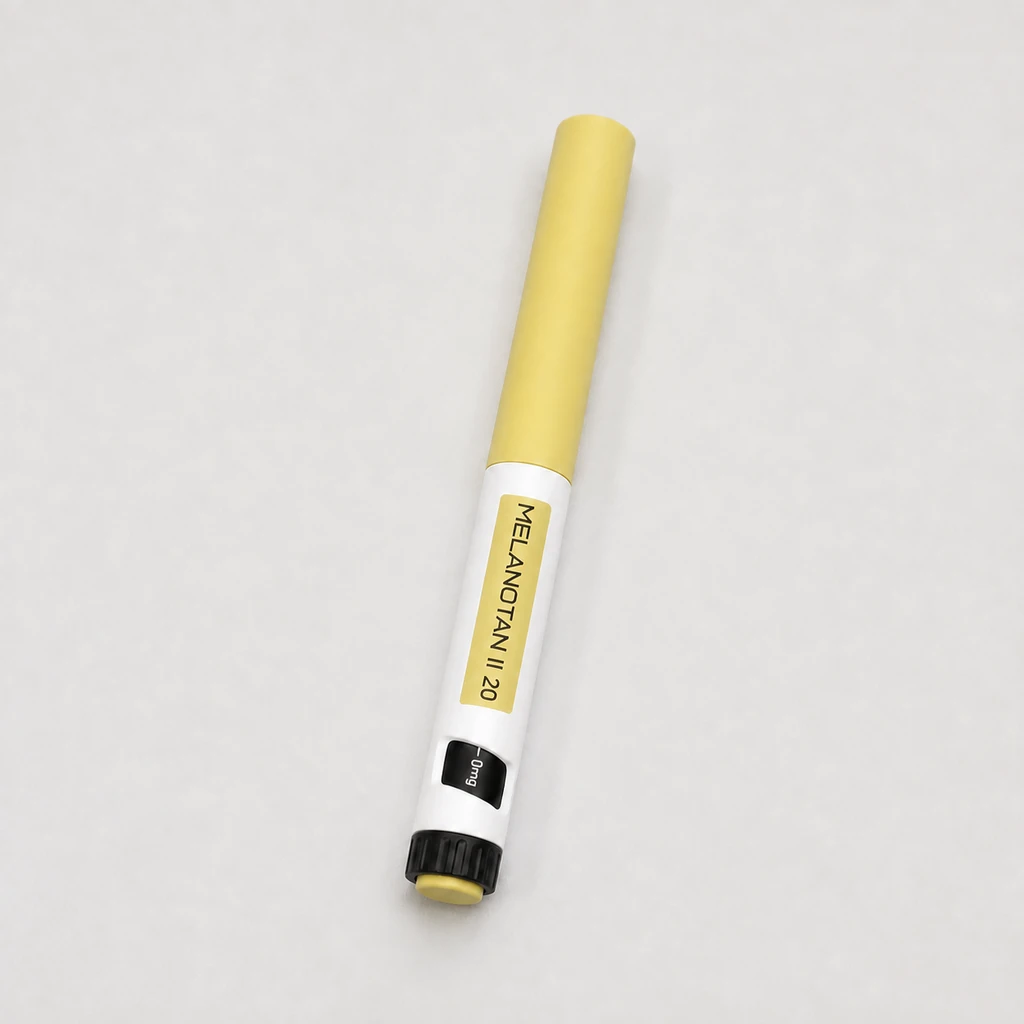
Our Melanotan II page identifies a 20 mg pen. It does not identify Scenesse or an afamelanotide implant. The 20 mg figure is total labelled content, not an instruction, a comparison with an implant or a promise about how someone will look.
For an enquiry, use the exact product link and ask about documentation for that item. If you are asking because of diagnosed photosensitivity or another skin condition, the medical question belongs with the clinician treating it. A catalogue name cannot establish a substitute for a prescribed medicine.
If your comparison is cosmetic rather than medical, our Melanotan II, bronzer and self-tanner guide separates those product categories. Keeping the purpose explicit helps avoid treating a cosmetic objective and a medical indication as one decision.
Questions readers ask
Does the name Melanotan mean an approved medicine?
No. Identify the exact active substance and product. An authorization for Scenesse does not establish an authorization for every item carrying a related name.
Can a pen be compared with the implant by milligrams?
The quantities identify their respective contents. They do not establish interchangeable exposure, effect or instructions across different molecules and formulations.
Does darker pigmentation replace sun protection during a Bali stay?
No. A pigmentation change is not permission to extend sun exposure or a substitute for sun protection. The medical context of Scenesse should not be used to imply otherwise for Melanotan II.
Sources
Source and editorial checks completed. How these articles are prepared.