In this article
MOTS-C and CJC/Ipamorelin belong to different research discussions. MOTS-C is a mitochondrial-derived peptide; CJC/Ipamorelin combines two compounds associated with growth-hormone signalling. If you are comparing pens in Bali for an exercise or body-composition goal, start by defining what you want measured. A shared “performance” category does not make the products substitutes.
What is actually in the two pens?
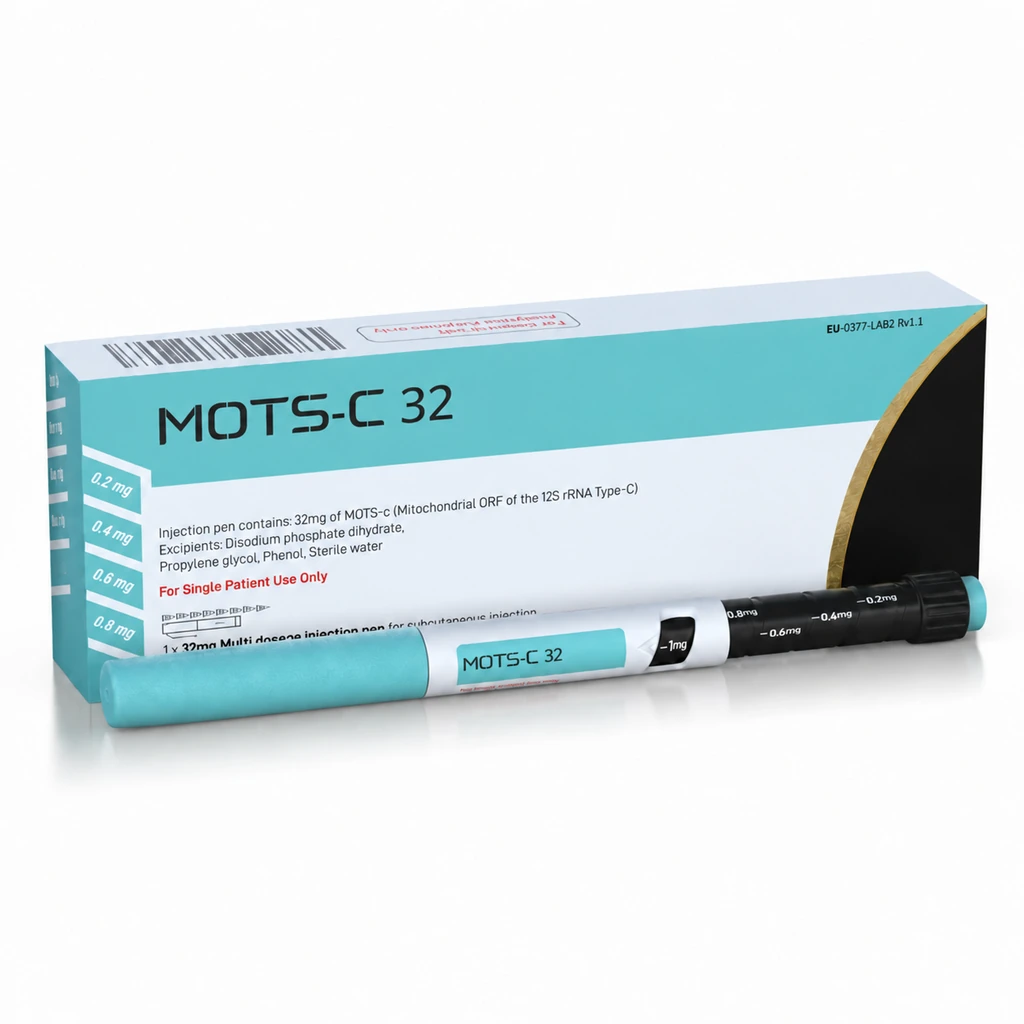
The catalogue lists MOTS-C as a 32 mg single-compound pen and CJC/Ipamorelin as 10 mg plus 10 mg, 20 mg total. These are descriptions of contents. Comparing 32 with 20 cannot establish strength, effectiveness or a personal amount to use.
| Question | MOTS-C | CJC/Ipamorelin |
|---|---|---|
| Product structure | One peptide | Two-component blend |
| Research context | Mitochondrial signalling and exercise-related observations | GHRH/ghrelin-related hormone signalling |
| Example measurement | Endogenous peptide response around exercise | GH and IGF-1 response in particular studies |
| Missing link to check | Does the study test administered MOTS-C in the relevant people? | Does the study test this exact blend and CJC form? |
For the individual listings, see MOTS-C and CJC/Ipamorelin. They are not different sizes of one medicine.
An exercise association is not a pen trial
The Nature Communications MOTS-C paper includes observations about naturally occurring MOTS-C around human exercise, alongside experimental work. A change in an endogenous molecule after exercise does not automatically show that administering a retail product reproduces exercise's benefits.
This is an important distinction in product comparisons. “Associated with exercise” and “shown to improve exercise performance when administered in this preparation” are different statements. The first can motivate research without establishing the second.
The separate MOTS-C exercise article examines that question in more detail. Here, the key point is that the evidence is not on the same scale as simply measuring how much ingredient a pen contains.
Hormone measurements answer a different question
The CJC-1295 human study measured hormonal effects of a long-acting research compound. It did not establish that every CJC/Ipamorelin blend improves a particular gym performance measure. The precise CJC identity matters when matching a product to a study.
Ipamorelin research in postoperative bowel function provides another example: a human trial can be real while addressing an outcome unrelated to a customer's training goal. Counting publications without checking their participants and endpoints is therefore not a useful way to choose between the pens.
Turn an unclear goal into a useful question
“More energy” could mean less daytime tiredness, a longer exercise session, better sleep or more stable training attendance. Those outcomes need different assessment. Likewise, “recovery” might mean pain after an injury, ordinary soreness or returning to an earlier performance level.
Before discussing a product, write one concrete outcome and how it is currently measured. Bring relevant medical history and medicines to a qualified clinician. This gives the conversation an anchor and reduces the temptation to treat every wellness label as an answer to the same problem.
For someone staying in Bali briefly, also explain the available follow-up period. A change after travel, altered training or a new sleep schedule cannot automatically be assigned to a peptide. Keeping those details recorded helps prevent a confident interpretation of a very ambiguous personal experiment.
What a fair comparison should include
Ask whether the evidence concerns an endogenous observation, a laboratory experiment or an administered product in people. Then identify the route, formulation and endpoint. Finally, check whether the claim being made is narrower than the evidence or exceeds it.
This approach leaves room for genuine scientific interest without converting every promising mechanism into a retail promise. It also makes a decision clearer: you may need a more precise clinical assessment rather than another product comparison.
FAQ
Is MOTS-C another growth hormone secretagogue?
It is discussed as a mitochondrial-derived peptide, not as the same GHRH/ghrelin-related blend as CJC/Ipamorelin.
Does more total milligrams mean a stronger effect?
No. Different molecules and a two-component blend cannot be ranked by adding or comparing their masses.
Can I combine them because they act through different pathways?
Different mechanisms do not prove that a combined regimen is effective or appropriate. These cited studies do not establish the clinical benefit of that combination.
Is a rise in GH enough to show better performance?
No. A hormone measurement and a functional performance outcome answer different questions.
Sources
- MOTS-c is an exercise-induced mitochondrial-encoded regulator of age-dependent physical decline and muscle homeostasis
- Prolonged stimulation of growth hormone and insulin-like growth factor I secretion by CJC-1295 in healthy adults
- Prospective, randomized, controlled, proof-of-concept study of ipamorelin for postoperative ileus
Source and editorial checks completed. How these articles are prepared.