Tesamorelin and CJC-1295 are different modified versions of the body's growth hormone-releasing signal. In Bodypharm's catalog, the comparison also changes the composition: Tesamorelin is offered as one ingredient, while CJC-1295 appears alongside Ipamorelin in a two-peptide pen.
What the two pens contain
| Catalog offer | Declared content per pen | Composition |
|---|---|---|
| Tesamorelin | 32 mg | One named peptide |
| CJC-1295 + Ipamorelin | 10 mg + 10 mg | Two named peptides, 20 mg combined |
Ipamorelin is the second ingredient in the blend, with its own 10 mg content statement. A shopper comparing these offers is therefore choosing between different complete compositions. The 32 mg and 20 mg totals describe the contents of the respective pens, rather than a shared scale of biological potency.
A clear meaning for “analogue”
Growth hormone-releasing hormone, GHRH, is the body's signal prompting the pituitary to release growth hormone. Here, an analogue means a modified version of that natural signaling molecule.
Tesamorelin retains the human signal's 44-amino-acid sequence with an added chemical group at one end. This is a concrete distinction in its design, described in the EGRIFTA WR label.
The original CJC-1295 design used a modified portion of the releasing signal plus a group enabling attachment to albumin, a blood protein. That albumin-binding feature underlies the long-acting design in the original CJC-1295 development study. Bodypharm's CJC-1295 entry does not specify DAC status, so the catalog leaves that particular molecular detail open.
Different clinical contexts
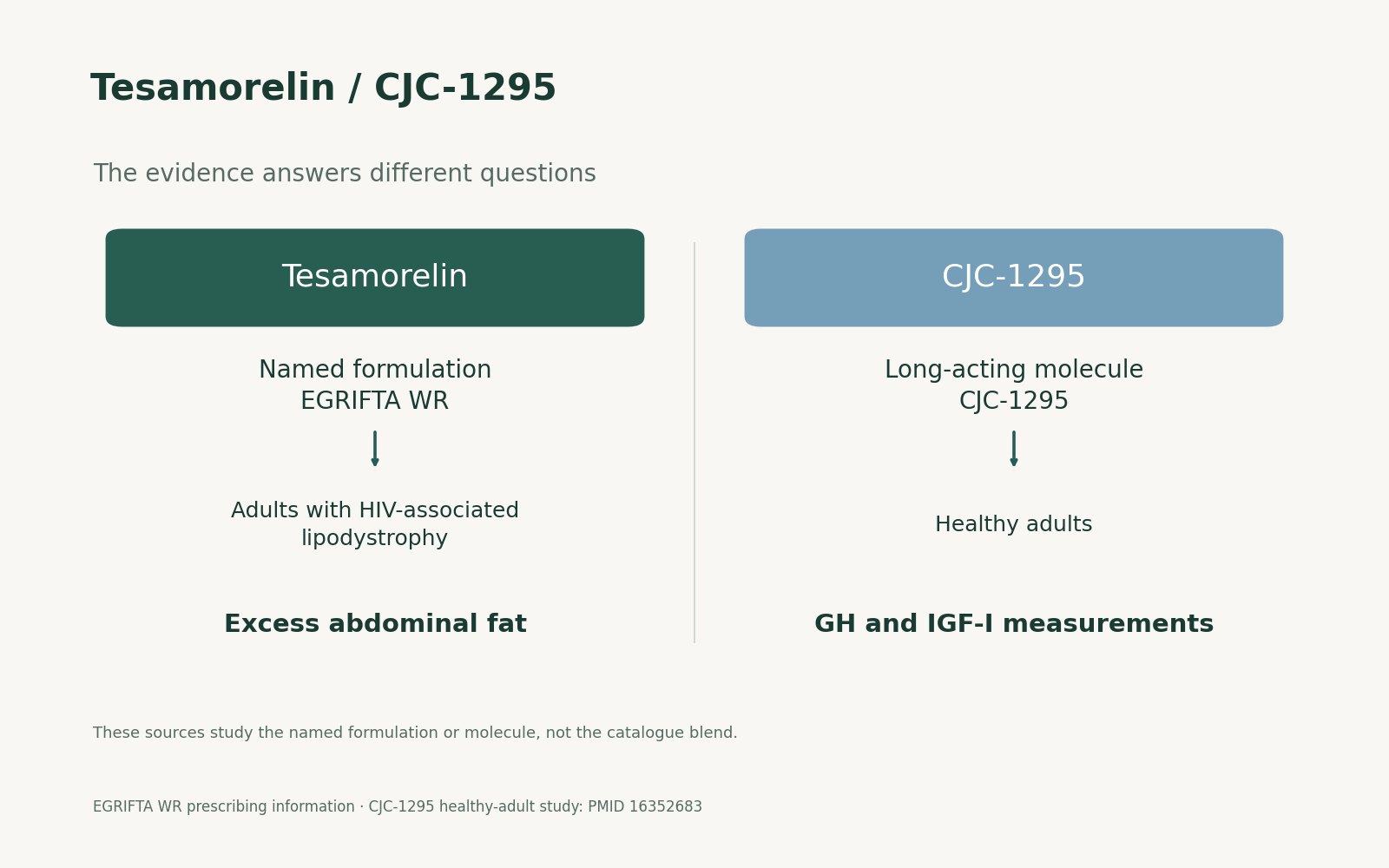
EGRIFTA WR's labeled Tesamorelin use concerns excess abdominal fat in adults with HIV-associated lipodystrophy. That context belongs to the named medicine and its formulation.
The CJC-1295 human trials studied the long-acting molecule in healthy adults and measured growth hormone and IGF-I responses. These hormone measurements establish the response under those study conditions; they do not measure muscle gain or recovery from an injury.
The practical catalog difference remains straightforward: a Tesamorelin-only pen versus a CJC-1295/Ipamorelin blend. Knowing that composition keeps the molecular comparison relevant to the actual two offers.
Sources
- EGRIFTA WR (tesamorelin) official prescribing information
- Prolonged stimulation of growth hormone (GH) and insulin-like growth factor I secretion by CJC-1295, a long-acting analog of GH-releasing hormone, in healthy adults
- Human growth hormone-releasing factor (hGRF)1-29-albumin bioconjugates activate the GRF receptor on the anterior pituitary in rats: identification of CJC-1295 as a long-lasting GRF analog
Source and editorial checks completed. How these articles are prepared.