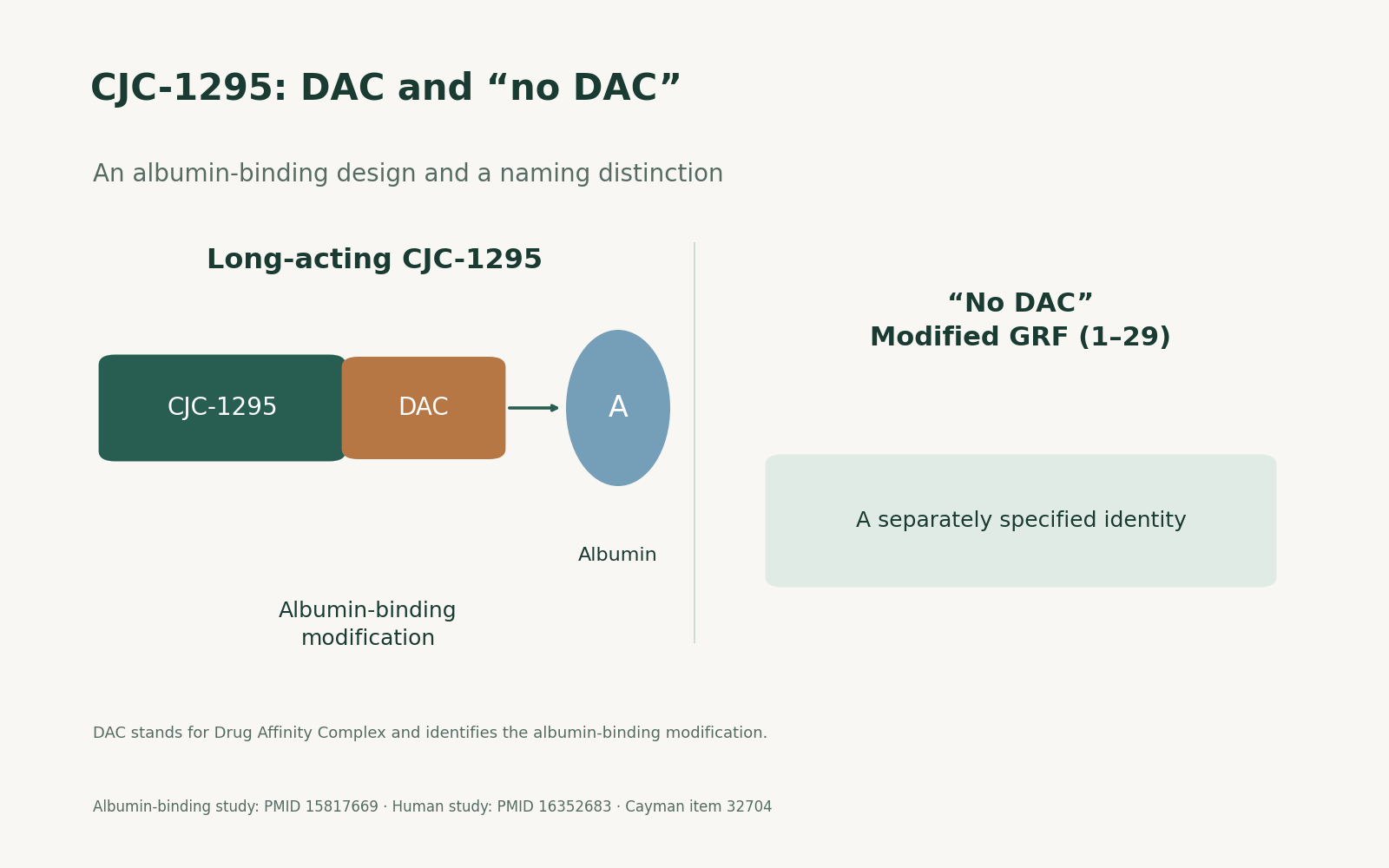
DAC stands for Drug Affinity Complex. In the long-acting CJC-1295 design, it refers to a modification that enables binding to albumin, a blood protein. A product called “CJC-1295 without DAC” therefore needs to be distinguished from the albumin-binding molecule in the original long-acting studies. Molecular-design paper.
What albumin binding changes
The original work examined a modified growth hormone-releasing factor peptide with a reactive group that could attach to albumin. The design aimed to keep the signal available longer in circulation. Experiments with cells and rats supported the development of this long-lasting analogue.
The later healthy-adult CJC-1295 trials measured growth hormone, IGF-I and pharmacokinetics. They estimated a half-life of 5.8–8.1 days for the studied long-acting form. Half-life describes how a measured concentration declines; it is not an instruction for how often to use a product. Human trial.
That figure belongs to this molecular design. It should not be attached to an unspecified no-DAC label simply because the front of both listings says CJC-1295.
Where modified GRF fits
Commercial terminology is not completely uniform. For example, Cayman Chemical lists one reagent as CJC-1295 acetate and gives Modified GRF (1–29) and CJC-1295-no DAC as synonyms. Its specification describes that particular supplied substance. Manufacturer’s product record.
This is a concrete reason to read beyond the short title. “CJC-1295,” “CJC-1295 with DAC” and “modified GRF” may be used in overlapping ways by different suppliers. The actual sequence and albumin-binding modification are more precise identifiers than the umbrella name.
Apply the distinction to a blend
The Bodypharm CJC-1295/Ipamorelin listing states 10 mg + 10 mg per pen but does not currently identify DAC status. The amount answers how much of each ingredient is declared. It does not answer which CJC-related molecule is intended.
A concise clarification is: “Which sequence is supplied as CJC-1295, and does it include the albumin-binding DAC modification?” The answer can then be matched to the appropriate molecular and human studies.
This is primarily an identity question. Resolving it makes comparisons of CJC-1295 products, or explanations of why one is paired with ipamorelin, much more accurate before any discussion of expected effects.
Sources
- Human growth hormone-releasing factor (hGRF)1-29-albumin bioconjugates activate the GRF receptor on the anterior pituitary in rats: identification of CJC-1295 as a long-lasting GRF analog
- Prolonged stimulation of growth hormone (GH) and insulin-like growth factor I secretion by CJC-1295, a long-acting analog of GH-releasing hormone, in healthy adults
- CJC-1295 (acetate), Item 32704 — Cayman Chemical
Source and editorial checks completed. How these articles are prepared.