In this article
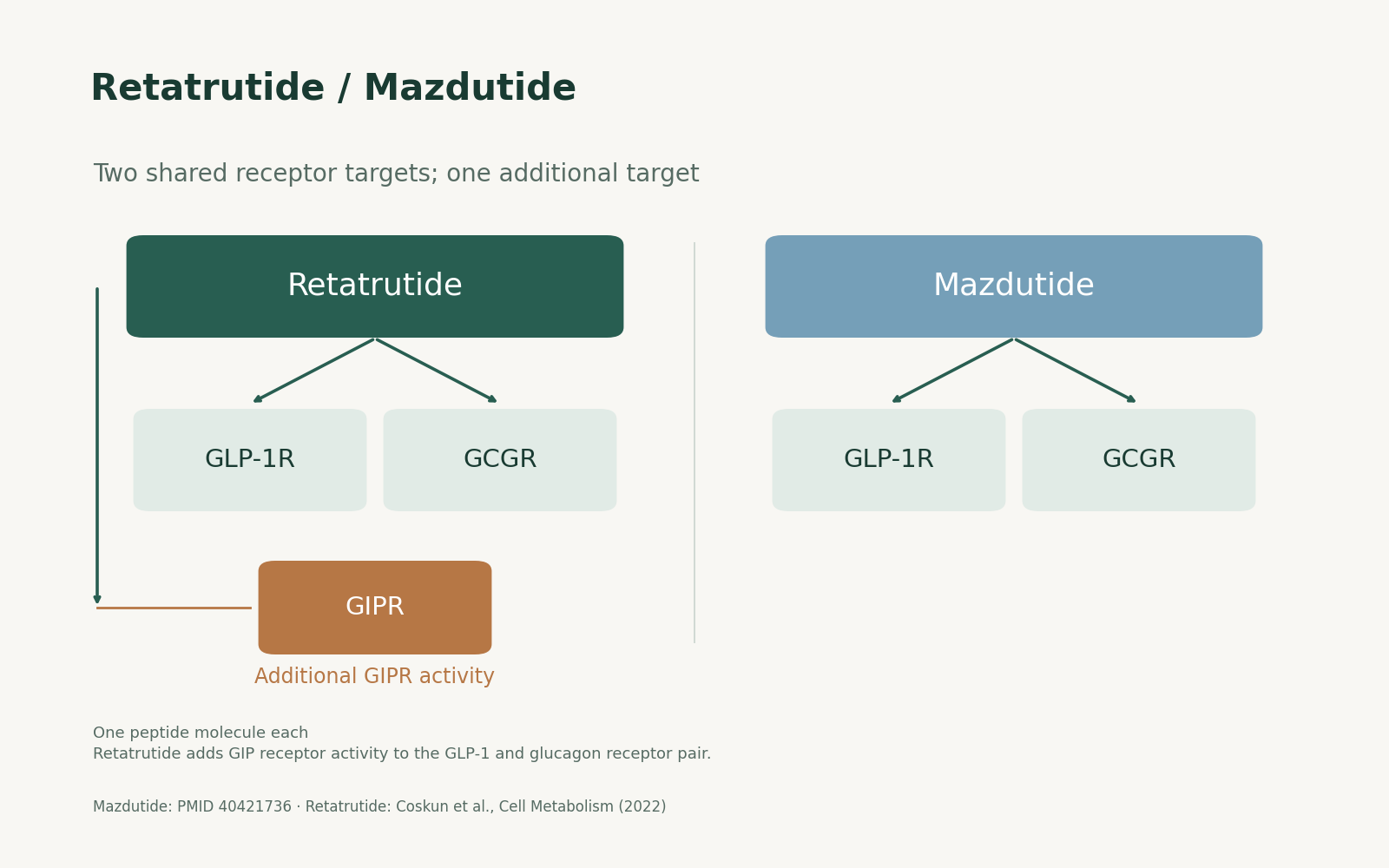
Mazdutide combines GLP-1 and glucagon receptor activity. Retatrutide combines those two targets with GIP receptor activity. Both are single peptide molecules designed to engage more than one receptor, so the most specific difference is retatrutide's additional GIP pathway. Mazdutide trial; retatrutide development study.
A dual agonist can mean different pairs
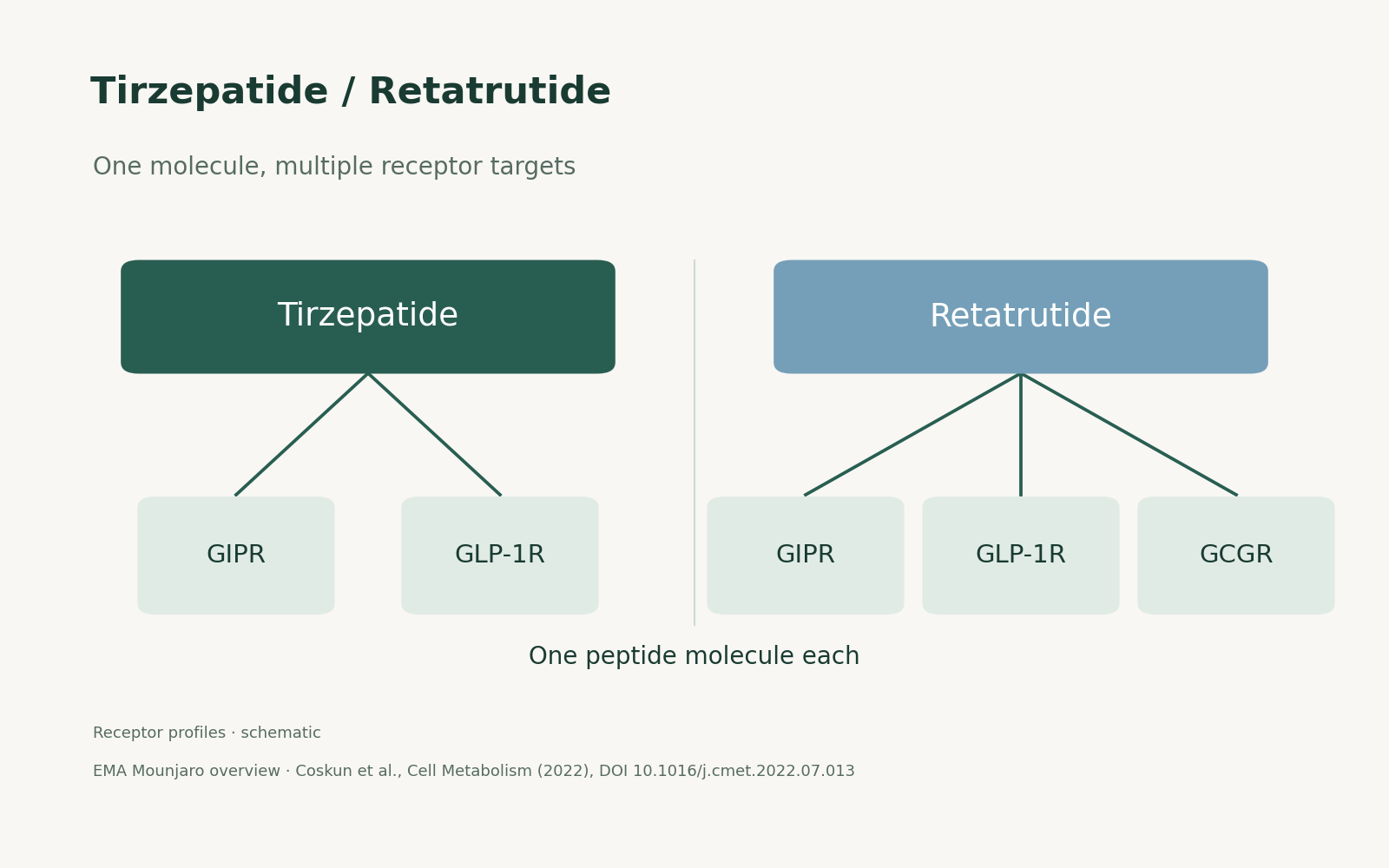
The word “dual” is incomplete without the receptor names. Mazdutide's pair is GLP-1/glucagon. Tirzepatide, another dual agonist readers may know, uses GIP/GLP-1. Retatrutide brings all three targets into one molecule.
GLP-1 and GIP participate in meal-related metabolic signaling; GLP-1 activity also connects with appetite regulation. Glucagon activity adds a different metabolic route. Retatrutide's development work explored its contribution to energy expenditure in mice, which helps explain the design without turning that experiment into a human performance claim. Meal-related receptor context.
| Molecule | Receptor profile |
|---|---|
| Mazdutide | GLP-1 + glucagon |
| Retatrutide | GLP-1 + glucagon + GIP |
Neither row describes a premixed kit. Each name identifies a compound with its own structure and pharmacology.
The clinical programs answer their own questions
GLORY-1 studied mazdutide in 610 Chinese adults with obesity or overweight. Treatment lasted 48 weeks, with its primary weight outcomes assessed at week 32. The trial demonstrated weight reduction against placebo in that population. GLORY-1.
Retatrutide's phase 3 TRIUMPH-1 enrolled 2,339 adults with obesity without diabetes and reported its main weight results at 80 weeks. The publication appeared in September 2026. TRIUMPH-1.
The different populations, durations and trial designs make a simple cross-trial league table misleading. These studies provide results for defined regimens; they do not directly isolate the value of adding GIP by comparing mazdutide and retatrutide against each other.
How this helps a buyer compare descriptions
A useful description names the receptor pair or trio, then links results to the actual compound and study. “Dual” versus “triple” alone leaves out the biological difference.
If the question is how the molecules differ, look at GIP and the complete molecular design. If the question is a finished product, the formulation and its documentation are a further comparison. The presence of glucagon in both profiles does not make the two ingredient names interchangeable.
Sources
- Once-Weekly Mazdutide in Chinese Adults with Obesity or Overweight
- LY3437943, a novel triple glucagon, GIP, and GLP-1 receptor agonist for glycemic control and weight loss: From discovery to clinical proof of concept
- Retatrutide, a Triple Hormone Receptor Agonist, for Treatment of Obesity
- Mounjaro — European Medicines Agency
Source and editorial checks completed. How these articles are prepared.