Five years of growth hormone follow-up: why carotid wall thickness is not a count of heart attacks
A vascular study in adults with growth hormone deficiency followed common carotid artery wall thickness across five years of replacement research.
A vascular study in adults with growth hormone deficiency followed common carotid artery wall thickness across five years of replacement research. The measured layers can be assessed by imaging. A change in their thickness does not count cardiovascular events or directly establish a difference in survival.
Locate the vascular measurement before interpreting it
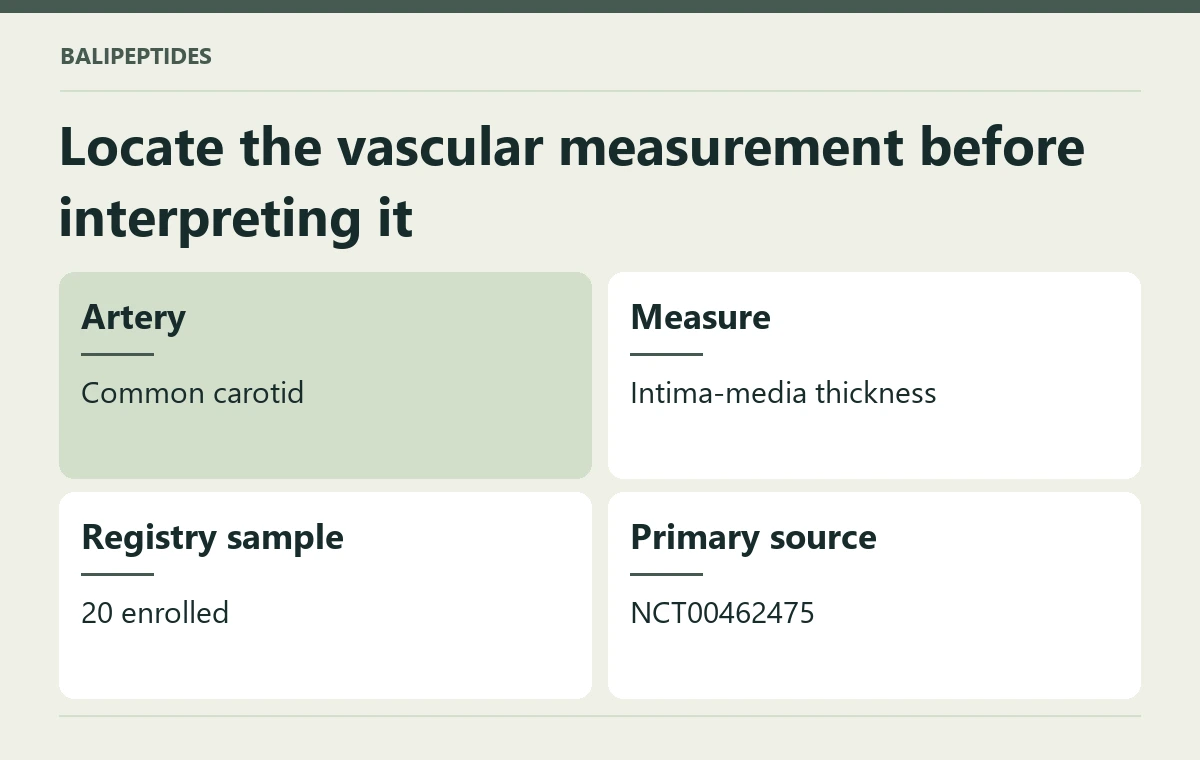
Keeping the arterial segment consistent matters. A value taken at the common carotid is not automatically comparable with a measurement from another site or a differently defined plaque assessment. Five years of observation gives a long time axis for the chosen measure. It does not supply a separate clinical endpoint simply by lasting a long time. When comparing a personal vascular report in Bali with this research, use the named arterial segment, method and clinical context before comparing numbers.
The method determines what a tissue number means
A carotid ultrasound measurement has a location and a unit of length. A heart attack has a date and a clinical definition. Five years of repeated scans can document a pattern in the artery wall, yet the number of scans does not create an independently assessed count of cardiovascular events.
A wall-thickness value is a continuous measurement. A heart attack is an event with a date and clinical definition. Converting one into the probability of the other requires evidence beyond their appearance in the same cardiovascular discussion. It matters particularly in a small study, where the sample may be adequate for repeated imaging but too small for a reliable estimate of event rates.
Participant and measurement details
- People in the record: 20 (actual enrollment). Eligible ages: 18 years to 50 years. Male participants only.
- Clinical setting: Hypopituitarism, Pituitary Tumors.
- Named study interventions: Recombinant Growth Hormone, Genotropin (Pfizer).
- Study design: observational, case control, prospective.
- Measured here: Common carotid intima-media thickness at baseline and follow-up.
- Research locations listed in the record include: Naples, Italy.
- Primary record: Federico II University. ClinicalTrials.gov, NCT00462475.
The Somatropin listing for Bali documents the commercial form, whereas an ultrasound report documents the artery, side and measurement convention. Keeping both records clearly labelled helps a clinician avoid reading an anatomical measurement as a treatment outcome in an individual patient.
