GHK-Cu and collagen synthesis: what can a dish of fibroblasts actually show?
A fibroblast experiment can isolate a potential action of GHK-Cu.
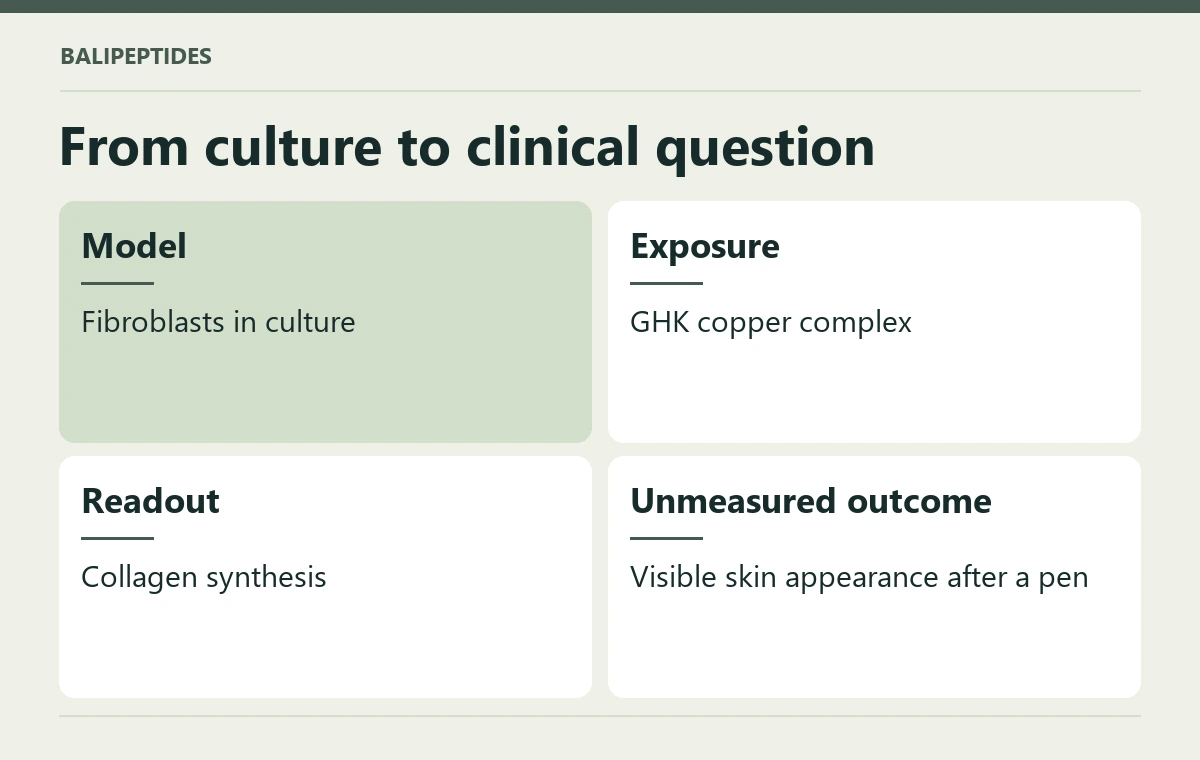
A fibroblast experiment can isolate a potential action of GHK-Cu. It cannot show a Bali resident what their skin will look like after using a particular product. To see why, start with the material on the laboratory bench. The scientists measured a property of living cells under controlled conditions. They did not photograph a person's skin before and after a course of treatment.
Identify where the measured collagen came from
Fibroblasts help produce components of the extracellular matrix. Studying them in culture lets researchers vary exposure and examine the response without having to disentangle sunlight, other skincare, genetics or changes in hydration. That control is a strength for the mechanistic question. A dish also lacks the full structure of skin, product penetration from the surface, circulation and the everyday exposures a person experiences. A positive measure of synthesis does not tell us how much newly made material persists, how it is organized in intact tissue, or whether a visible outcome follows.
The investigators exposed fibroblast cultures to the copper complex of glycyl-L-histidyl-L-lysine and measured collagen synthesis. The unit of observation was a cell culture. This allowed the team to isolate a particular biochemical process. It did not include volunteers receiving a pen, a comparison of skincare products, or blinded photographs of visible skin changes. Those designs would need different participants, controls and endpoints. GHK-Cu fibroblast experiment
A 50 mg label answers a narrower question
The Bali GHK-Cu listing identifies a 50 mg presentation. That number gives no concentration in the cell-culture medium. Nor can it be translated into an expected improvement in texture, firmness or pigmentation. When reading a product description that cites a collagen paper, find the experimental material, the measured substance and the reported unit before accepting the leap to a visible outcome. Evidence for a named serum, an injectable presentation or a clinical skin measure would require a study of the relevant formulation and endpoint.
Ask what happens after synthesis
Even within the question of collagen, making protein is only part of the story. Its organization, turnover and persistence influence the properties of a tissue. Measuring newly synthesized material during a culture experiment cannot tell us how fibres are arranged months later. That distinction helps explain why a cellular finding can justify further research without supporting a before-and-after photograph or a promise of visible change.
