Tirzepatide in SURPASS-6: what changed when basal insulin stayed in place?
The decisive detail in SURPASS-6 sits in the word “added”.
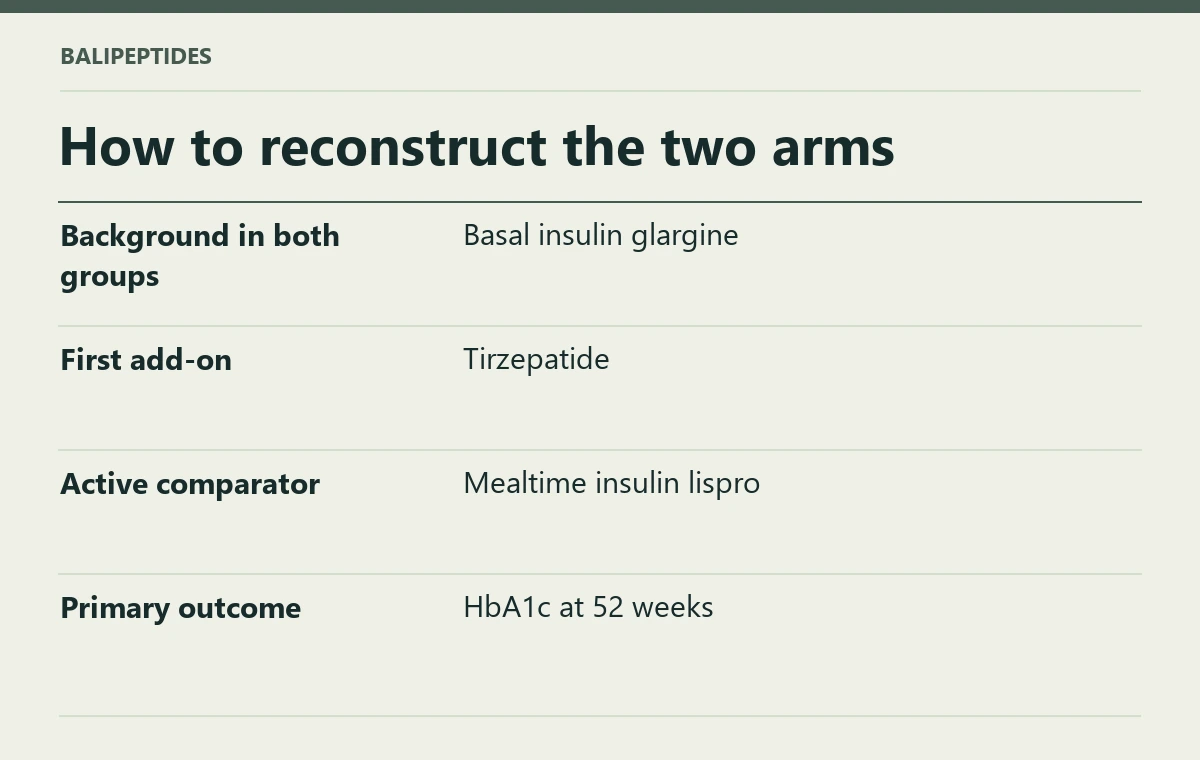
The decisive detail in SURPASS-6 sits in the word “added”. Investigators compared two ways of intensifying treatment for adults with type 2 diabetes who were already using basal insulin. A reader in Bali looking for an insulin-versus-tirzepatide verdict should keep the existing glargine in both columns of the comparison. Removing it silently changes the clinical question.
Draw the trial as two complete treatment lines
Write “glargine plus tirzepatide” on one line and “glargine plus lispro” on the next. Under each, write the same baseline condition and the same follow-up point. Now the headline result has an interpretable setting. It concerns a choice between add-on strategies in a defined population. It does not test stopping all insulin and switching to a catalogue pen. It also tells us little about someone without diabetes who is interested principally in weight change. The comparator is an active treatment, so a difference between groups is not the same quantity as change from each group's own starting point.
In SURPASS-6, adults with type 2 diabetes already receiving basal insulin were assigned to add either tirzepatide or mealtime insulin lispro. Both strategies sat on top of insulin glargine. Glycated haemoglobin at 52 weeks was the primary efficacy outcome. The researchers also followed body weight and hypoglycaemia. Those are different outcomes: an average glucose marker cannot tell you how many individual low-glucose events occurred. SURPASS-6 randomized trial
Where the Bali product amount fits
The local Tirzepatide listing shows the contents of two commercial pen options. A total on the pen is an inventory detail. It is not one of the study's outcome measurements. If discussing this paper with a clinician, bring the name of the background treatment and the outcome that matters to you. An average HbA1c change, a count of low-glucose episodes and a change in body weight describe different trade-offs. Keeping those three lines separate makes for a much clearer conversation than asking whether one drug “won”.
Read the direction of the comparison
On a trial graph, start at baseline, follow each group to the specified visit and only then compare the two arms. A group can improve from its starting level while still differing from the other group at the end. If a summary gives only a percentage, look for whether it describes a share of participants, a change in HbA1c or a relative difference. Those denominators do different work.
