Retatrutide device bridging: what does similar exposure tell you about two presentations?
A device-bridging study can compare how a substance reaches the bloodstream from two defined presentations.
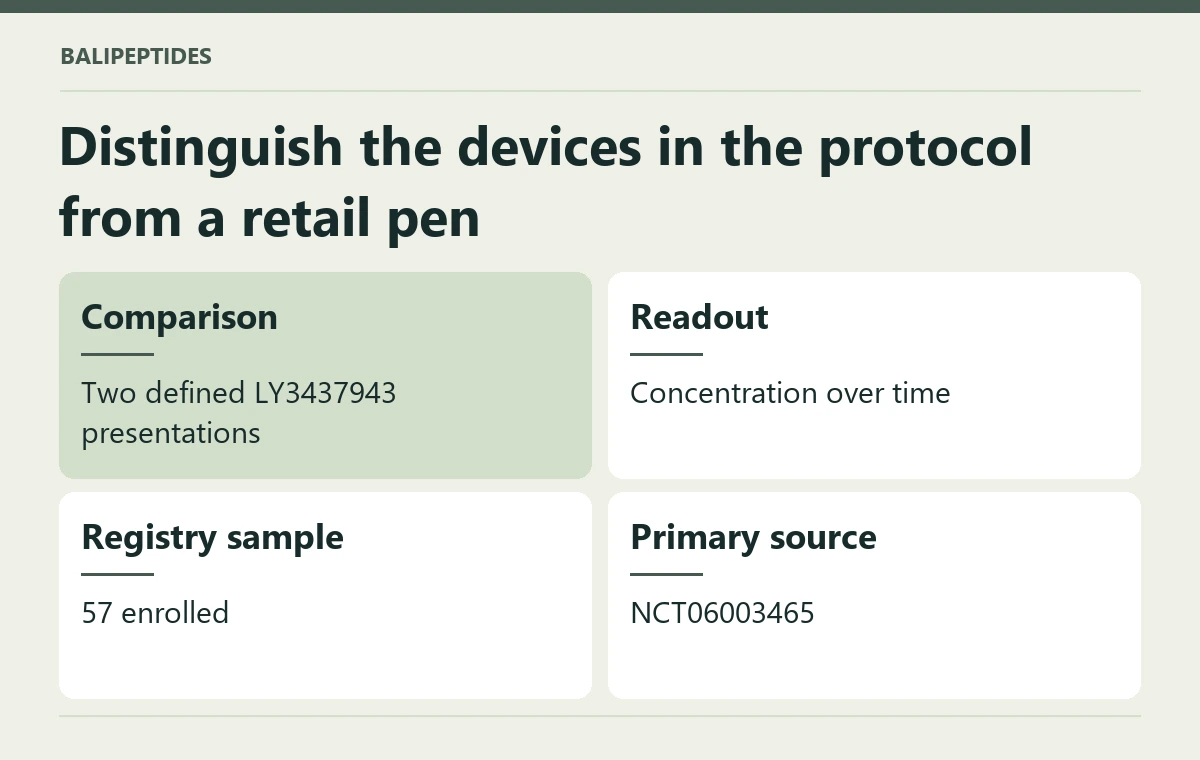
A device-bridging study can compare how a substance reaches the bloodstream from two defined presentations. That is useful when researchers change how an investigational formulation is delivered. It does not turn any two pens sharing a molecule name into interchangeable products. The registry for LY3437943 makes the specific device question visible.
Distinguish the devices in the protocol from a retail pen
Imagine two devices that deliver the same total amount under the protocol. One might yield a different peak or a different time to reach that peak. That is the reason to measure the resulting profile rather than infer it from the label. Even a reassuring comparison between the two trial presentations would apply to the formulations and devices actually evaluated. The retail product in front of a reader in Bali would need documented identity and a matching presentation before such a conclusion could reasonably be transferred.
Read the shape of an exposure curve
A useful device-comparison graphic would put time since administration on the horizontal axis and measured retatrutide concentration on the vertical axis, with a line for each presentation. If a brochure shows only the pens side by side, it is missing the observation that would make a claim about exposure testable.
Similarity is always similarity under a chosen criterion. A laboratory group might compare concentration profiles against prespecified statistical limits. That does not establish equivalence of the device's instructions, markings or performance for every person handling it. A photograph of two pens can show their appearance, but cannot replace the concentration measurements or the study's definition of an acceptable difference.
Participant and measurement details
- People in the record: 57 (actual enrollment). Eligible ages: 18 years to 70 years.
- Clinical setting: Healthy.
- Named study interventions: LY3437943, Test, Reference.
- Study design: phase 1, interventional, randomized, crossover.
- Measured here: Retatrutide peak concentration after the studied presentations.
- Research locations listed in the record include: Miami, United States and San Antonio, United States.
- Study calendar in the registration: start 2023-08-29; primary completion 2024-02-08.
- Primary record: Eli Lilly and Company. ClinicalTrials.gov, NCT06003465.
If a Bali pack is offered as the same presentation, ask for the exact manufacturer, device identification and documentation tying that presentation to the comparison. The local Retatrutide page names a 32 mg option. That content line alone cannot identify either investigational device. Keep the product question and the experimental comparison side by side.
