Thymosin beta-4 eye drops and TB-500: why a corneal staining score cannot be carried over to a pen
A study about an eye drop can turn up when a Bali customer searches for TB-500.
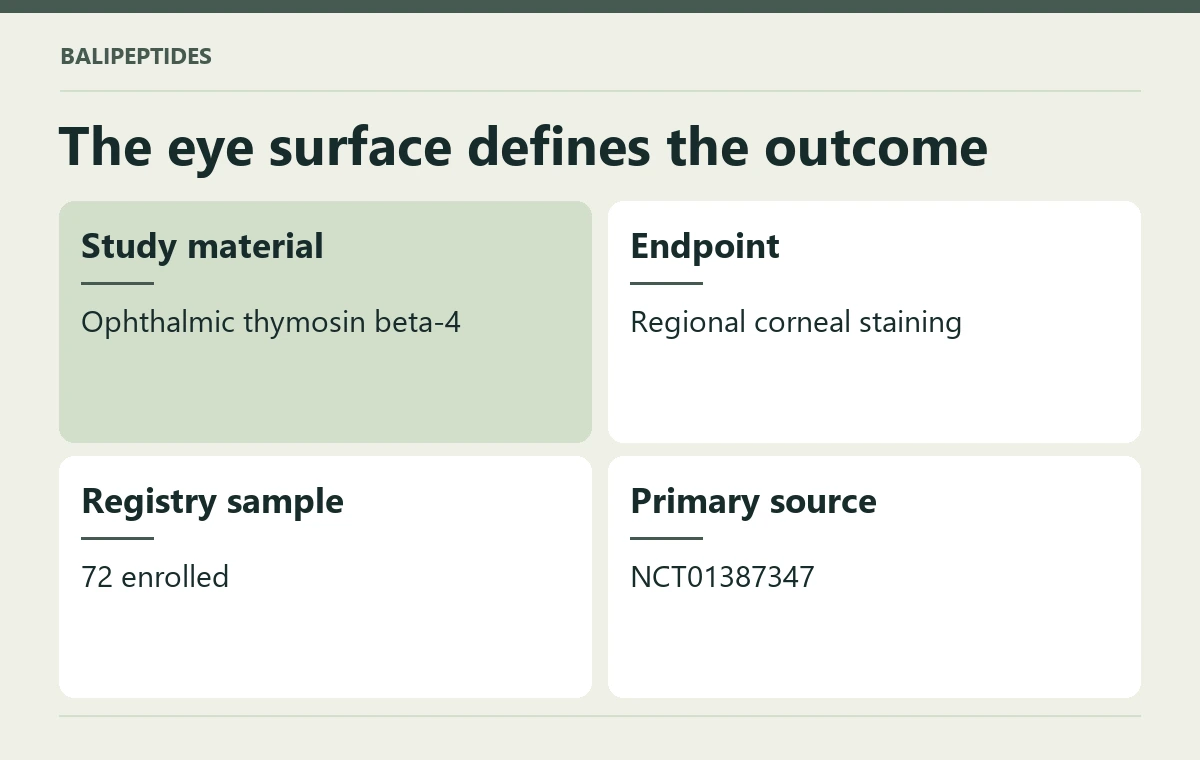
A study about an eye drop can turn up when a Bali customer searches for TB-500. The dry-eye protocol studied thymosin beta-4 in an ophthalmic preparation and evaluated corneal staining. The locally listed blend has a different product identity and route. The cornea is the starting point for interpreting the study.
The eye surface defines the outcome
The controlled environment in the protocol helps investigators observe the eye surface under specified conditions. The primary measure selects a particular corneal region and an assessment visit. That design does not measure tendon stiffness, knee pain or changes after a systemic blend. A customer comparing claims should copy the full substance name and formulation from the study, rather than reducing the name to “thymosin”. Even within eye disease, staining on an examination and the discomfort a participant reports need separate labels and may tell different stories.
The route and formulation belong beside the molecule's name
Corneal staining describes a feature of the eye surface observed with a specified examination. A paper about drops applied locally to that surface has a route, formulation and endpoint particular to the eye. A pen bearing a related peptide name cannot inherit the numerical eye result from the drops in that experiment.
Staining can be scored by region. A reported difference in the lower part of the cornea is a narrower observation than a change in the entire eye surface. The comparison also uses an ophthalmic formulation suited to that tissue. The more precise the original design becomes, the less plausible it is to cite it as an all-purpose result about soft-tissue repair.
Participant and measurement details
- People in the record: 72 (actual enrollment). Eligible ages: 18 years to 85 years.
- Clinical setting: Dry Eye Syndrome, Dry Eye.
- Named study interventions: Thymosin beta 4, Placebo.
- Study design: phase 2, interventional, randomized, parallel. Masking: quadruple.
- Measured here: Staining of a specified region of the cornea.
- Study calendar in the registration: start 2011-08; primary completion 2011-10.
- Primary record: ReGenTree, LLC. ClinicalTrials.gov, NCT01387347.
The Bali blend lists 16 mg of each of two named components. If a product comparison starts with this blend and ends with dry-eye research, ask where the exact substance, formulation and measured tissue were matched. In this example those details visibly diverge.
