Tesamorelin and nerve repair: why the study measures a three-point pinch
Gripping a key, buttoning a shirt and pinching a small object do not make identical demands on a recovering hand.
Gripping a key, buttoning a shirt and pinching a small object do not make identical demands on a recovering hand. A registered study of tesamorelin after peripheral nerve injury chose a three-point pinch test as a primary measure. The particular grip matters more than the broad term “regeneration”.
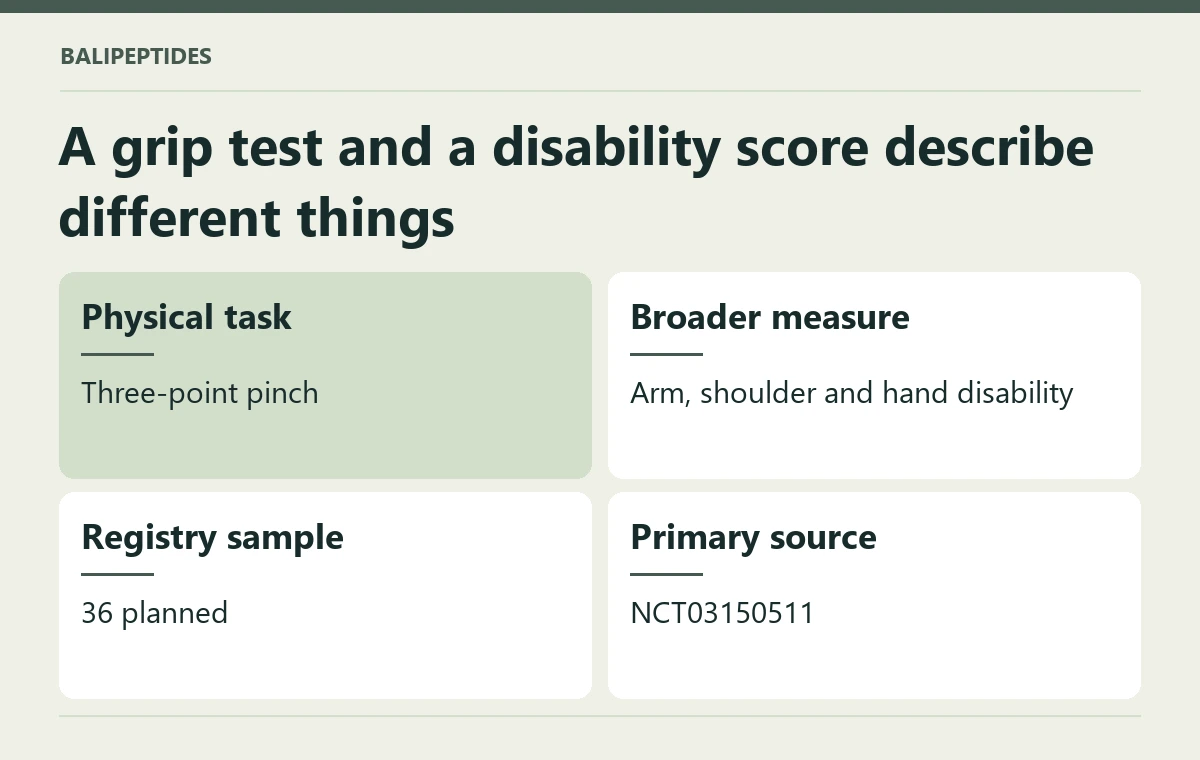
A grip test and a disability score describe different things
The three-point chuck position brings the thumb against two fingers. A measurement in this position can quantify one kind of hand force during follow-up. It cannot directly count regrowing nerve fibres or establish that touch sensation has returned. The protocol also lists a disability score for the arm, shoulder and hand, which asks a broader functional question. For a patient following surgery, both measures can be informative while disagreeing. The registered outcomes describe how a hypothesis will be evaluated; they are not a promise of a particular recovery after treatment.
Specify what the participant actually did
A three-point pinch uses a particular grip. Someone may improve at that task while still finding it difficult to turn a key or lift a pan. If an article reports “hand function,” check whether it actually gives a pinch-force result, a different hand test, or an account of activity at home.
In practical terms, pinch force can be relevant to handling coins or opening a small fastening. Those activities also require sensation, dexterity and pain control. A force reading therefore captures only part of the everyday task. An outcome sheet that includes the injured side, time after repair and comparison condition is easier to interpret than an isolated statement that hand function “returned”.
Participant and measurement details
- People in the record: 36 (planned enrollment). Eligible ages: 18 years and older.
- Clinical setting: Peripheral Nerve Injuries.
- Named study interventions: Tesamorelin 2 Milligrams (MG).
- Study design: phase 2, interventional, randomized, parallel. Masking: quadruple.
- Measured here: Three-point pinch in the injured upper extremity.
- Research locations listed in the record include: Baltimore, United States.
- Study calendar in the registration: start 2018-06-01; planned primary completion 2027-12.
- Primary record: Johns Hopkins University. ClinicalTrials.gov, NCT03150511.
On Bali, Tesamorelin is catalogued by total content. A person considering a hand-function study has a more useful starting point in their surgical report: which nerve was injured, where the repair was made, how much time has passed, and which movement is currently difficult. These facts define the clinical comparison.
