Retatrutide outcomes research: what “time to the first event” counts when several events are possible
Large cardiovascular and kidney outcomes studies often analyze time to a first qualifying event.
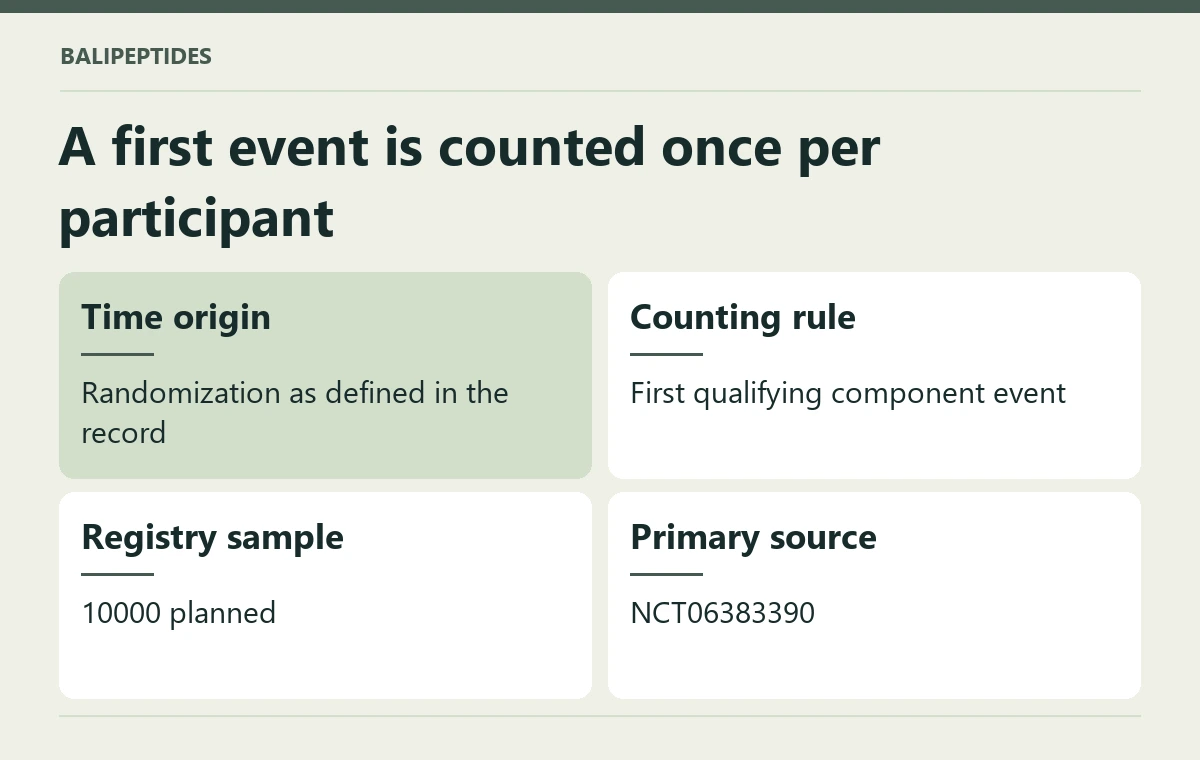
Large cardiovascular and kidney outcomes studies often analyze time to a first qualifying event. That endpoint can include several clinically different components. The retatrutide outcomes registration specifies composite questions and a large planned enrollment. A sample target says how the trial is designed, not how many events have occurred.
A first event is counted once per participant
Consider one participant who experiences two qualifying events at different dates. The earlier date sets their first-event time; the later event may still matter clinically without becoming a second first event in this analysis. Participants who have not experienced an event can contribute observation time. Understanding which events enter each composite and how follow-up is handled is more informative than simply noting that heart and kidney disease both appear in the trial title.
A combined endpoint has its own denominator
If the endpoint is the first qualifying event, a participant with two events does not contribute two first events. The order and dates matter, and the reported composite does not reveal automatically which type of event was most common. Look for the individual components when interpreting a statement about a particular outcome.
Suppose one type of event is substantially more common than the other components. It can contribute much of the numerical pattern in the composite. A reader assessing an eventual overall difference should examine component-specific results and uncertainty before saying that every component changed to the same degree. The fact that a study intends to examine several outcomes is not itself a report of an equal effect on all of them.
Participant and measurement details
- People in the record: 10000 (planned enrollment). Eligible ages: 45 years and older.
- Clinical setting: Atherosclerotic Cardiovascular Disease (ASCVD), Chronic Kidney Disease (CKD).
- Named study interventions: Retatrutide, Placebo.
- Study design: phase 3, interventional, randomized, parallel. Masking: double.
- Measured here: Time to the first qualifying cardiovascular or kidney event under the protocol definitions.
- Research locations listed in the record include: Alabaster, United States and Birmingham, United States.
- Study calendar in the registration: start 2024-04-30; planned primary completion 2029-02.
- Primary record: Eli Lilly and Company. ClinicalTrials.gov, NCT06383390.
The Retatrutide option in Bali does not predict whether a particular person will experience any event. For a clinical claim about prevention, ask which qualifying event, in which population, over what follow-up the cited research actually measured.
