Tesamorelin and cognition in ageing people with HIV: keep the adherence support in the study description
A trial about cognition may include support for following its procedures as well as a pharmacological intervention.
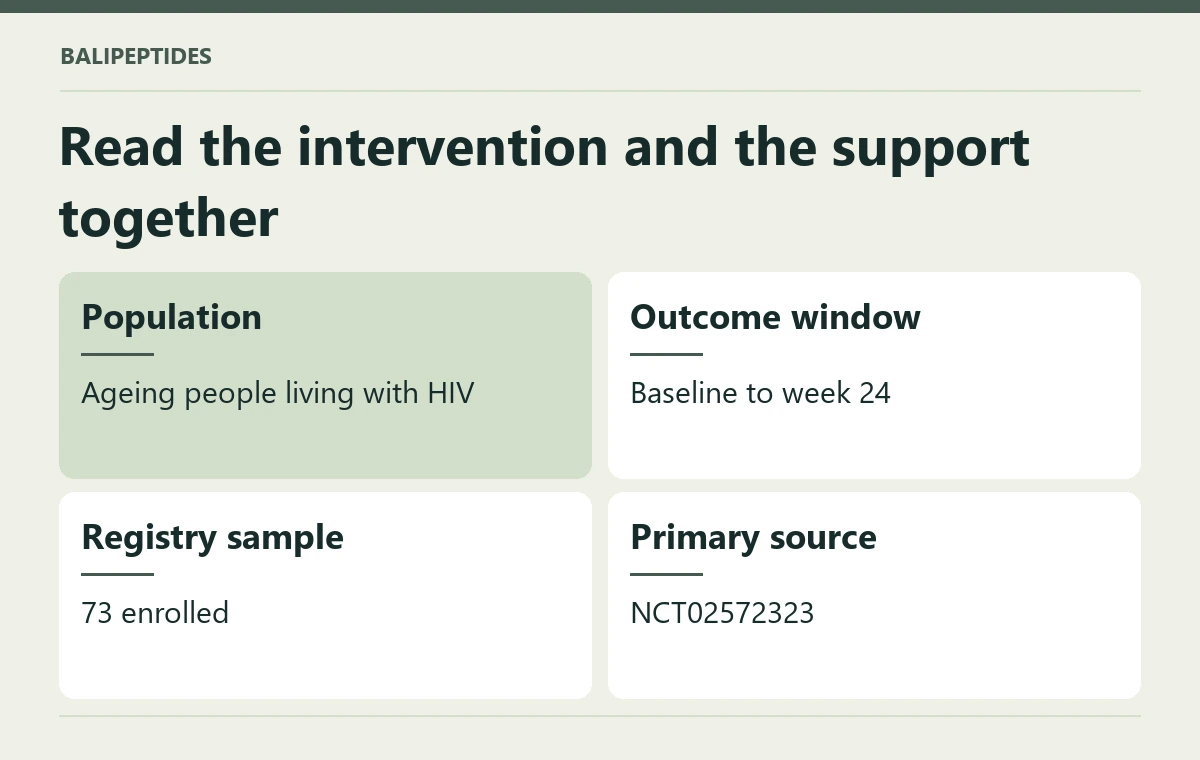
A trial about cognition may include support for following its procedures as well as a pharmacological intervention. The registration for a tesamorelin study in ageing people with HIV explicitly discusses a text-message component. The primary measure concerns neurocognitive performance, assessed at baseline and week 24.
Read the intervention and the support together
A reminder can influence how often participants complete study activities without itself representing a drug effect. The protocol and publication should be checked for which support each group received. A clinician interpreting cognitive concerns also considers background illness, medicines, language and baseline performance. A change in an endocrine marker such as IGF-1, listed separately in the study, would not replace a cognitive assessment. The existence of a mechanism hypothesis does not collapse those outcomes into one.
Work out what the comparison group contributes
Imagine reading a summary that mentions only the injection and a memory test. If the participants also received help maintaining a treatment routine, leaving that out changes the intervention being described. Note which groups received the support and what the cognitive assessment involved before attributing an observed difference to tesamorelin alone.
Language can affect a cognitive assessment differently from an endocrine laboratory measurement. Instructions, test familiarity and repeated visits can change the interpretation of a score. A paper that links a change in IGF-1 to a change in cognitive performance needs to show the relationship with the appropriate analysis. Reporting that both were measured does not establish that one caused the other.
Participant and measurement details
- People in the record: 73 (actual enrollment). Eligible ages: 40 years and older.
- Clinical setting: Mild Cognitive Impairment.
- Named study interventions: Tesamorelin.
- Study design: phase 2, interventional, randomized, crossover. Masking: single.
- Measured here: Neurocognitive performance from baseline to the specified follow-up.
- Research locations listed in the record include: Los Angeles, United States and Palm Springs, United States.
- Study calendar in the registration: start 2017-02-15; primary completion 2023-10-15.
- Primary record: University of California, San Diego. ClinicalTrials.gov, NCT02572323.
A person in Bali discussing Tesamorelin and cognition can bring the actual test report and treatment history. The catalogue presentation alone cannot identify which neuropsychological tasks were used, whether a reminder program was part of the protocol or how scores changed.
