Growth hormone releasing hormone and the overnight average: why one morning blood draw is different
Growth hormone varies over time.
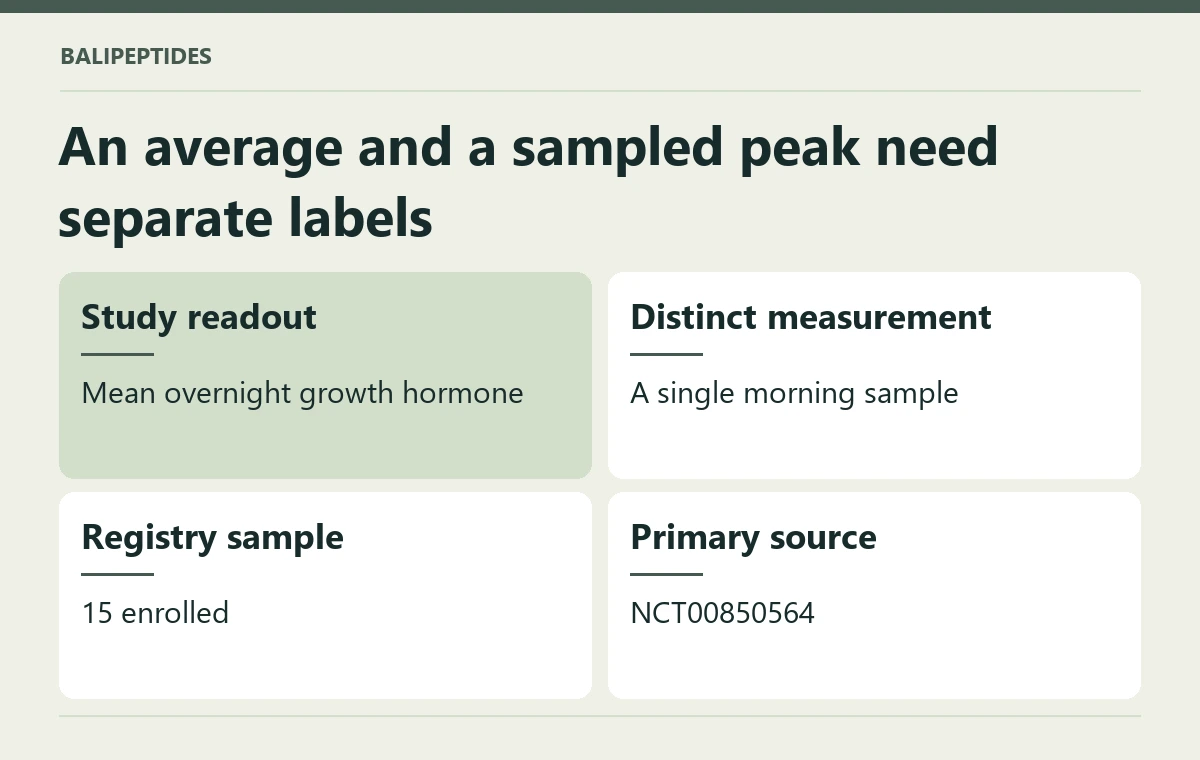
Growth hormone varies over time. A short research protocol in healthy men used mean overnight growth hormone as a primary endpoint after exposure to a growth hormone releasing hormone analogue. One morning result is a measurement at a moment; an overnight average combines information across a window.
An average and a sampled peak need separate labels
Two series could have the same overnight mean even if one contains a large brief rise and another shows smaller elevations for longer. To distinguish those patterns, the sampling interval and raw time series matter. Conversely, a single sample could catch a peak in one person and a trough in another. The study question concerns a defined physiological window, not a general sleep-quality score or an individual instruction for a pen. A clinician can select appropriate tests for a particular concern.
Distinguish a response from a resting measurement
Imagine that the first and last blood samples of the night have the same concentration. The intervening samples could still contain a series of peaks, changing the overnight average substantially. A morning result is one observation at one time, which is why repeated overnight measurements can answer a question a single draw leaves open.
An overnight mean needs reasonably defined collection hours and a rule for combining the samples. If two studies use different windows, a quiet interval or a pulse near the boundary can change their apparent averages. That methodological detail matters more than the fact that both graphs are labelled growth hormone. It is also why a casual comparison with a laboratory value obtained at a single morning appointment can be misleading.
Participant and measurement details
- People in the record: 15 (actual enrollment). Eligible ages: 18 years to 60 years. Male participants only.
- Clinical setting: Healthy Volunteers.
- Named study interventions: Growth Hormone Releasing Hormone (Tesamorelin).
- Study design: interventional, single group.
- Measured here: Mean overnight growth hormone following the short study intervention.
- Research locations listed in the record include: Boston, United States.
- Study calendar in the registration: start 2009-02; primary completion 2010-04.
- Primary record: Massachusetts General Hospital. ClinicalTrials.gov, NCT00850564.
The Bali Tesamorelin listing gives total content per pen, without any person's hormone profile. If the practical concern is daytime sleepiness or poor sleep, describe the symptom itself to a clinician; the study recorded a hormonal time series, not that symptom.
