Fasting glucose and a two-hour glucose challenge in a tesamorelin extension study
An extension study of TH9507 in HIV-associated lipodystrophy lists fasting glucose and the result of a two-hour glucose challenge separately.
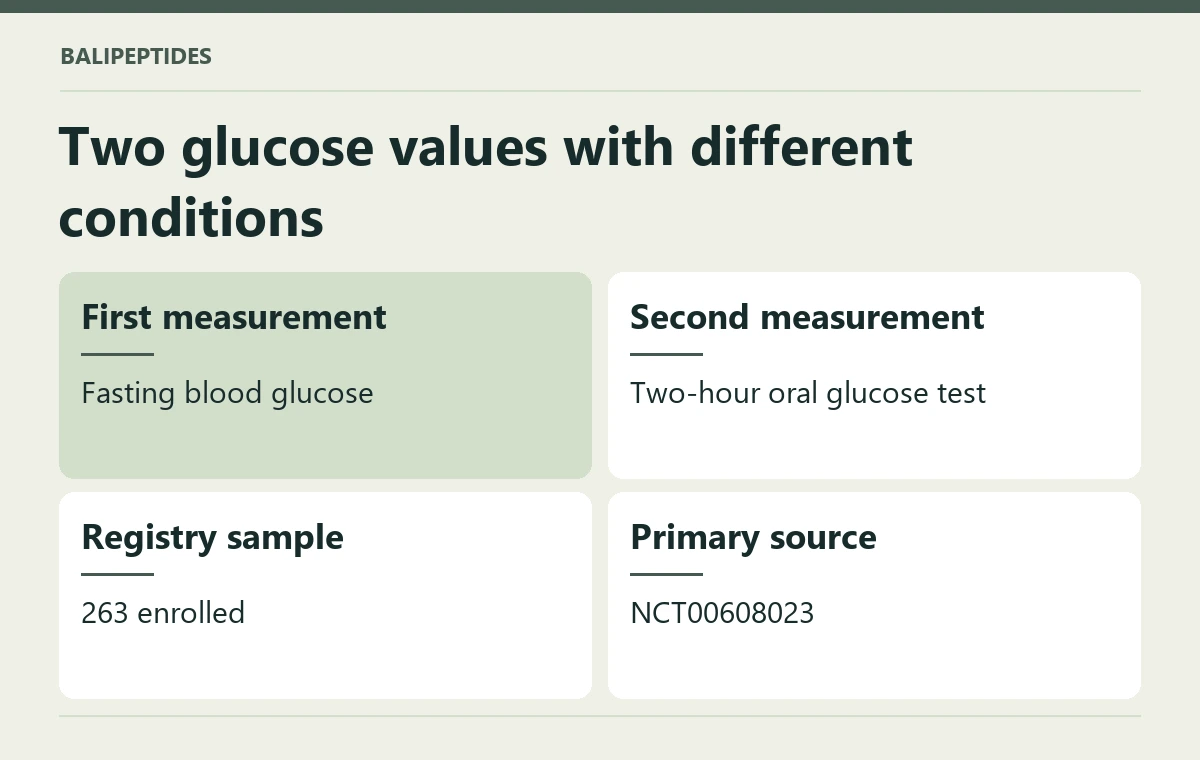
An extension study of TH9507 in HIV-associated lipodystrophy lists fasting glucose and the result of a two-hour glucose challenge separately. That pairing helps a reader see why “blood sugar” is too loose a description. One number comes from fasting conditions and the other follows a defined challenge.
Two glucose values with different conditions
A fasting result describes one baseline condition. A post-challenge result describes the body's response to a standardized exposure. Someone could have a modest change in one and a larger change in the other without the measurements being contradictory. An extension trial also draws from people who reached the extension, which can matter when comparing its participants with a fresh study population. Keep the two test conditions, the time window and participation history together when reading any long-term safety statement.
Distinguish a response from a resting measurement
Write “fasting” and “two hours after the challenge” in separate rows when copying the glucose results. They refer to deliberately different conditions, even when reported by the same laboratory in identical units. A change in one row cannot fill a missing value in the other or establish its direction.
An extension population can differ from the people who were originally eligible. Participants who discontinued earlier may have a different response or tolerability pattern from those who continued. The extension is useful for studying a particular longer-term course, but the denominator and follow-up interval must be retained when it is compared with the original trial or with a newly treated cohort.
Participant and measurement details
- People in the record: 263 (actual enrollment). Eligible ages: 18 years to 65 years.
- Clinical setting: Lipodystrophy, HIV Infections.
- Named study interventions: Tesamorelin, Placebo for Tesamorelin.
- Study design: phase 3, interventional, randomized, parallel. Masking: quadruple.
- Measured here: Change in fasting glucose and change after a two-hour oral glucose challenge.
- Research locations listed in the record include: Birmingham, United States and Phoenix, United States.
- Study calendar in the registration: start 2007-08; primary completion 2008-10.
- Primary record: Theratechnologies. ClinicalTrials.gov, NCT00608023.
The Tesamorelin presentation available in the Bali catalogue is a product identity. For an actual glucose report, note whether the sample was fasting, whether a defined oral challenge occurred and how long after it blood was collected. Those details determine which research measure is relevant.
