Tirzepatide kidney-function groups: what a single exposure experiment leaves unanswered
A study can include people with different degrees of kidney impairment to examine how drug concentrations behave.
A study can include people with different degrees of kidney impairment to examine how drug concentrations behave. The tirzepatide protocol registered timed blood sampling and pharmacokinetic endpoints. It does not follow from its design that the drug restored kidney function or that every patient in the same category will have the same response.
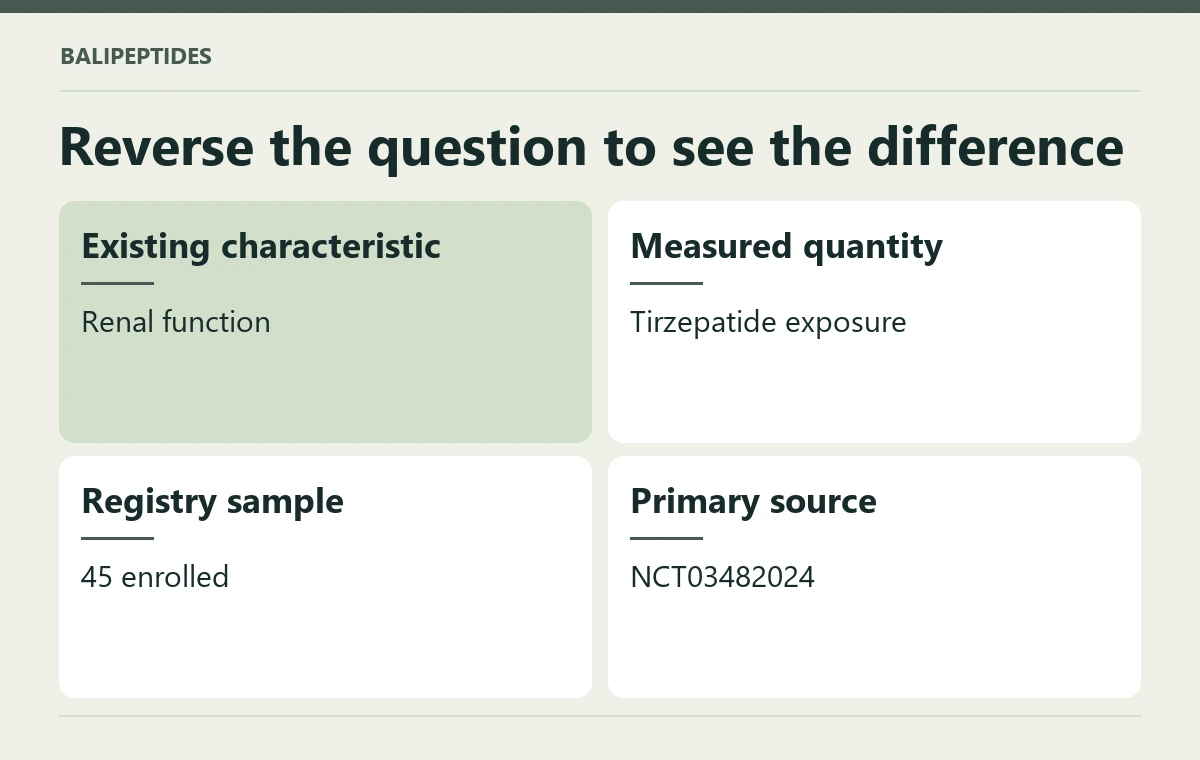
Reverse the question to see the difference
The research question can be phrased as what happens to tirzepatide in the body under different existing renal conditions. The reverse question, what tirzepatide does to kidney disease over time, is clinically important but distinct. Study size and follow-up suitable for a concentration profile need not be suitable for detecting a later kidney event. A clinician interpreting kidney status for an individual already uses actual measurements and medical history; a retail label only identifies the product being discussed.
Read the shape of an exposure curve
A single-dose comparison can sample the first hours closely enough to show a delayed peak, even though it never observes the same person after months of treatment. When reading the kidney-function table, keep the duration of sampling beside the group definitions. Those details tell you exactly how far the comparison travels.
The two directions of the question can even use the same participant labels. In an exposure experiment, renal status helps define the comparison before concentrations are followed. In a kidney-outcome trial, investigators follow an outcome such as a clinically defined deterioration under different treatment strategies. A numerical change in the first experiment cannot be automatically reinterpreted as kidney protection in the second.
Participant and measurement details
- People in the record: 45 (actual enrollment). Eligible ages: 18 years to 85 years.
- Clinical setting: Renal Insufficiency, End Stage Renal Disease.
- Named study interventions: Tirzepatide.
- Study design: phase 1, interventional, randomized, parallel.
- Measured here: Tirzepatide pharmacokinetics across renal-function groups.
- Research locations listed in the record include: Tustin, United States and Miami, United States.
- Study calendar in the registration: start 2018-03-30; primary completion 2019-08-19.
- Primary record: Eli Lilly and Company. ClinicalTrials.gov, NCT03482024.
The Tirzepatide catalogue entry in Bali describes complete pens. It cannot establish renal function or supply individualized prescribing guidance. If a study is being invoked, check whether kidney function was used to assemble the groups or whether it was the outcome whose change investigators tested.
