Brain NAD in the morning and evening: what a phosphorus MRI study set out to compare
Does a measurement taken after breakfast answer the same question as one taken that evening? A brain spectroscopy protocol examined NAD-related signals at two times of day.
Does a measurement taken after breakfast answer the same question as one taken that evening? A brain spectroscopy protocol examined NAD-related signals at two times of day. It used phosphorus magnetic resonance spectroscopy rather than a routine blood test. That distinction matters before any claim about an ideal time to use a commercial product.
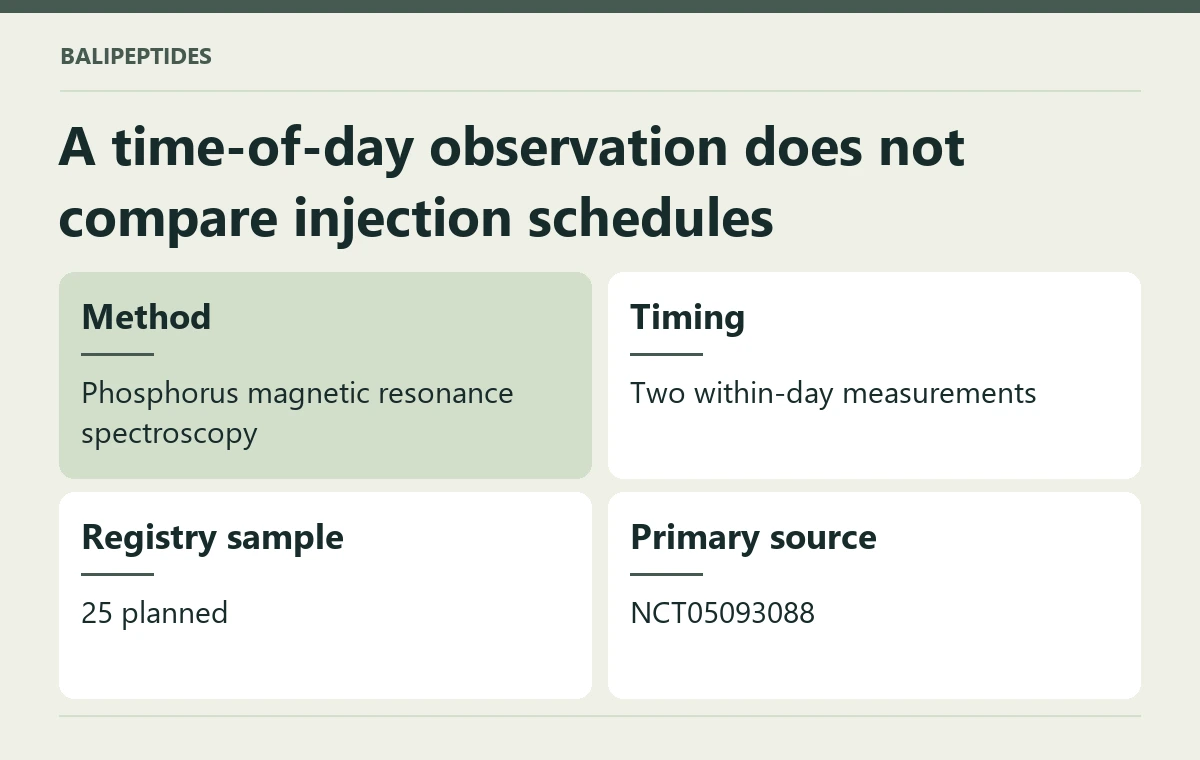
A time-of-day observation does not compare injection schedules
The study distinguishes oxidized and reduced forms as well as their relationship. A comparison within a day can help investigate temporal variation in a measured signal. It does not demonstrate that a pen administered in the morning or evening produces a better outcome: no such timing comparison follows from observing the signal alone. Sleep, meals and activities are relevant context for a time-of-day measurement. A useful report identifies the tissue, measurement time and analytical method instead of quoting an isolated NAD value.
The method determines what a tissue number means
Two entries reading “brain NAD” may represent visits at different hours of the day. Write the scan time and brain region down beside each number. Otherwise a morning-to-evening comparison can accidentally be described as a before-and-after treatment effect, even though the feature deliberately varied in the protocol was the time of measurement.
An oxidized-to-reduced ratio can change even when one of its constituents barely shifts. The numerator, denominator or both may have changed. A report that gives only a ratio should not be rephrased as an equivalent increase in each molecule. This matters when comparing a morning measurement with an evening measurement made under a defined spectroscopy protocol.
Participant and measurement details
- People in the record: 25 (planned enrollment). Eligible ages: 18 years to 40 years. Male participants only.
- Clinical setting: Circadian Rhythm.
- Study design: observational, cohort, prospective.
- Measured here: Brain NAD measures at morning and evening study visits.
- Research locations listed in the record include: Lausanne, Switzerland.
- Study calendar in the registration: start 2021-09-01; planned primary completion 2022-04-30.
- Primary record: Ecole Polytechnique Fédérale de Lausanne. ClinicalTrials.gov, NCT05093088.
A Bali retailer's NAD+ pen displays a total mass, not a brain NAD-to-NADH ratio. If a note claims that one time of day is best for treatment, check whether anyone was actually assigned to receive treatment at the competing times. This observation did not ask that question.
