Thymosin beta-4 gel and venous ulcers: why wound closure and tolerability were separate endpoints
A venous-ulcer study specified safety and tolerability of a topical thymosin beta-4 preparation as a primary outcome.
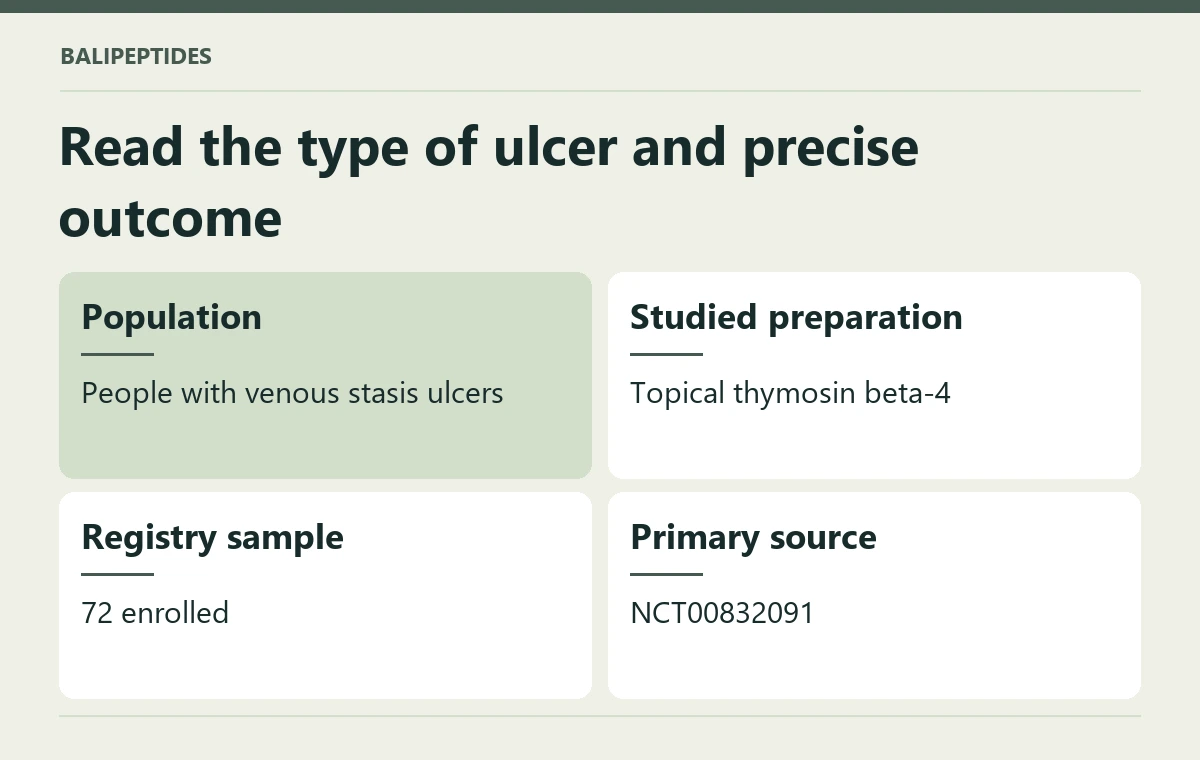
A venous-ulcer study specified safety and tolerability of a topical thymosin beta-4 preparation as a primary outcome. Wound closure was recorded separately. That ordering is worth keeping when a summary jumps from “tested in wounds” to “proved healing”, particularly if the product being discussed elsewhere is a BPC-157 plus TB-500 pen.
Read the type of ulcer and precise outcome
A product can be applied to a wound without demonstrating that more wounds close than under the comparison treatment. The registry identifies a follow-up of up to 84 days and defines a closure assessment that also considers drainage. A photograph taken on one particular afternoon cannot reconstruct that observation window. Venous ulcers arise in a specific clinical setting and require appropriate professional assessment. This research should not be read as instructions to use a local injectable blend on a wound or delay care.
The route and formulation belong beside the molecule's name
One participant might tolerate a gel well and still have an open ulcer at the final visit. Another might experience local irritation while the wound area decreases. Keeping those observations in separate columns respects the questions the ulcer study was designed to ask and avoids interpreting comfortable application as evidence that closure occurred.
A closure assessment can require both a closed surface and absence of drainage. A smaller measured area that still drains would not automatically meet that particular rule. Likewise, a wound can tolerate a gel well without reaching the closure criterion by the last assessment. Stating the rule in ordinary language makes potential headlines about “response” much easier to check.
Participant and measurement details
- People in the record: 72 (actual enrollment). Eligible ages: 18 years to 79 years.
- Clinical setting: Venous Stasis Ulcers.
- Named study interventions: Thymosin Beta 4, Placebo.
- Study design: phase 2, interventional, randomized, parallel. Masking: quadruple.
- Measured here: The tolerability of topical thymosin beta-4 in venous ulcers.
- Research locations listed in the record include: Bologna, Italy and Naples, Italy.
- Study calendar in the registration: start 2006-07; primary completion 2009-01.
- Primary record: RegeneRx Biopharmaceuticals, Inc.. ClinicalTrials.gov, NCT00832091.
A Bali catalogue search for BPC-157 and TB-500 leads to a pen carrying a blend. The venous-ulcer study instead sets a topical material against a particular type of wound. Keep both the route and the wound diagnosis in the notes if discussing this source.
