MOTS-c K14Q: how a mitochondrial DNA variant differs from a pen label
A change in mitochondrial DNA, a change in a peptide sequence and an association in a cohort are three different findings in MOTS-c research.
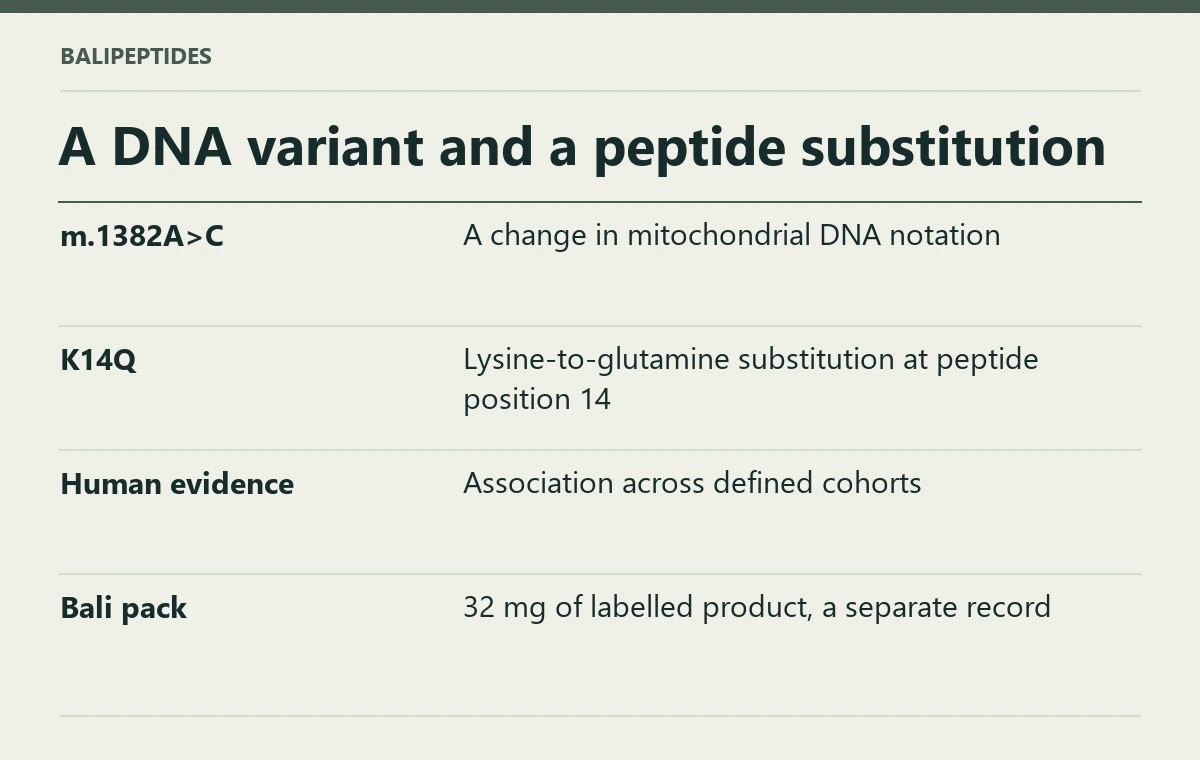
MOTS-c K14Q describes an amino-acid substitution at position 14 of a short mitochondrial-derived peptide. The K stands for lysine and the Q for glutamine. A human genetics study linked this substitution to a particular mitochondrial DNA variant, then investigated related biological questions in people, cells and mice. None of those steps identifies the sequence inside a commercially labelled pen in Bali.
Read the DNA notation and peptide notation separately
The researchers identify the mitochondrial DNA change as m.1382A>C. That is nucleotide-level notation. K14Q is protein-level notation describing the corresponding amino-acid change. The numbers differ because they refer to positions in different sequences. A person can follow a genetic association without assuming the study assigned anyone to receive a peptide. The human data describe characteristics and outcomes among people carrying different inherited variants. Original MOTS-c K14Q study
What the three cohorts contributed
The authors combined data from three cohorts including 27,527 participants. They reported a relationship between the variant and type 2 diabetes prevalence in men, with a physical-activity interaction examined in one cohort. Prevalence concerns the proportion of people with a condition in the group studied. It is different from an individual's future probability of developing diabetes. A subgroup result also needs its context: which cohort, how activity was classified, and whether the question was assessed in an independent population.
The animal and cell experiments asked related but different questions. Comparing administered peptides in mice can investigate a candidate mechanism under experimental conditions. It does not turn the human cohort into a trial of the same intervention. A combined paper can offer a convincing reason to study a mechanism further while leaving a therapeutic question in people unresolved.
Where a Bali product listing fits
The local MOTS-c catalogue page lists a 32 mg product. Milligrams identify the labelled total, while K14Q identifies the substitution described in the paper. Neither the amount nor the name can establish a shopper's genotype, the sequence of the actual product by analytical measurement, or a personal response. If someone cites the research for a product claim, ask which part they are citing: the population association, a cell experiment or the mouse intervention. These are legitimate findings with different implications. For an individual concerned about diabetes, the clinical starting point is a proper assessment, not inference from ancestry or a catalogue search.
The variant code identifies an amino-acid substitution at a particular position in the sequence.
