GHK-Cu and cis-urocanic acid: what does a three-part copper complex mean?
Researchers investigated copper, GHK and cis-urocanic acid in a chemical binding study. The result concerns a complex, not a clinical skin outcome.
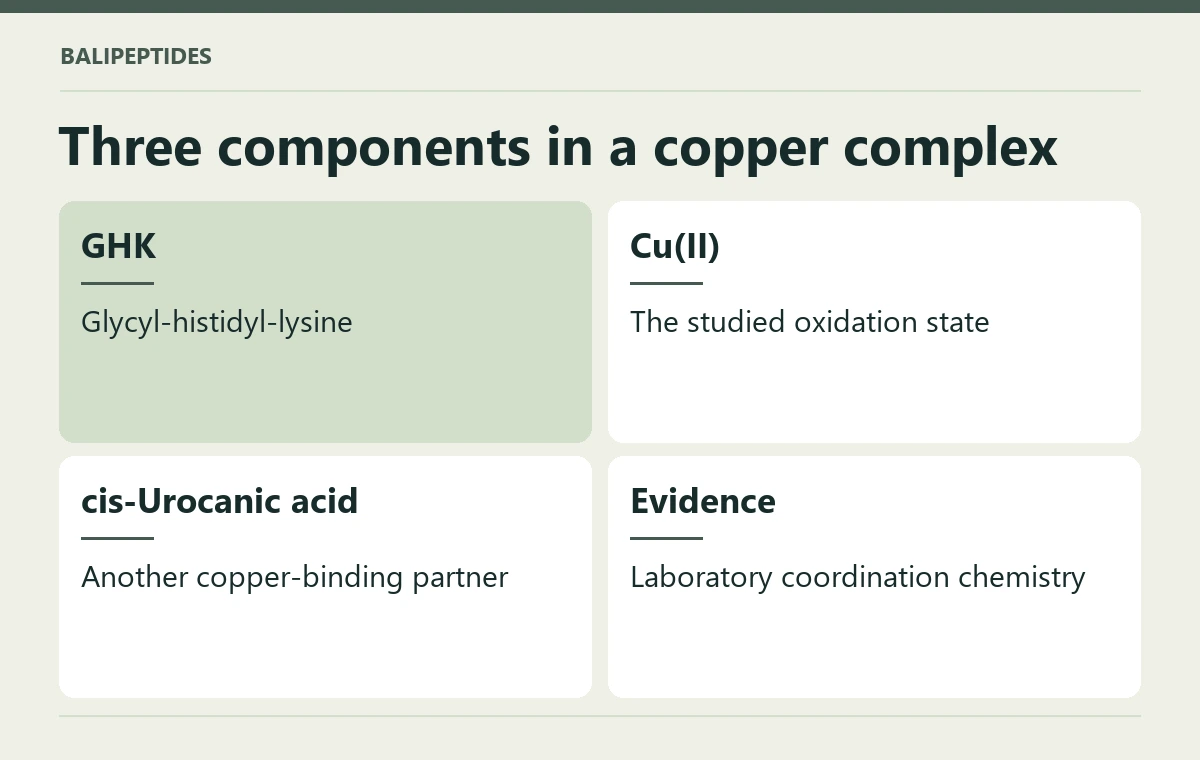
Copper can interact with more than one binding partner. Researchers examined GHK, copper in its Cu(II) state and cis-urocanic acid and found evidence for a complex involving all three. That observation is more precise than saying a product “works on skin”. The paper concerns chemical binding and a proposed biological interpretation, not visible changes in people using a finished formulation.
What the word ternary describes
GHK is the tripeptide glycyl-histidyl-lysine. Cis-urocanic acid is a separate molecule. A ligand is a binding partner that coordinates a metal ion. The authors investigated how urocanic acid binds copper and how it can take part in a complex alongside GHK. Ternary identifies the three participants in that complex. It does not describe three treatments assigned to volunteers or a three-ingredient pack that was tested in a shop. Original coordination-chemistry study
Why the surrounding mixture matters
Knowing that GHK binds copper is a starting point. The chemistry of a mixture also depends on the other molecules available and the experimental conditions. The researchers considered binding affinities alongside concentrations relevant to some human tissues. They proposed that the three-part species could contribute to effects discussed in the biological literature. This is a hypothesis about what might occur in a tissue environment. It is not a direct measurement of how a person's skin looks after an intervention.
There are three questions worth writing out. Can the chemical species form under studied conditions? Are the binding affinities and concentrations compatible with its proposed presence in tissue? Does a defined finished product produce a clinically relevant outcome? The first two can motivate the third without answering it. A mechanistic proposal should be described with the precision it earned, because replacing it with a broad claim removes what the experiment actually established.
Reading the Bali product label
The GHK-Cu page for Bali identifies a pen labelled 50 mg. That does not give the concentrations of every binding partner in a particular person's skin. Nor does it establish that cis-urocanic acid is inside the pen or state how much copper would occupy a particular complex. When reading a citation attached to a catalogue description, check whether the investigators studied the finished formulation, measured chemical binding or tested a visible outcome in people. For this paper, the answer concerns coordination between copper and two other molecules. A product-specific formulation or clinical claim needs its own evidence.
