Melanotan II testing: how identifying a molecule differs from confirming milligrams per vial
A published analysis measured identity, total content and impurities in Melanotan II vials. Each result answered a separate question.
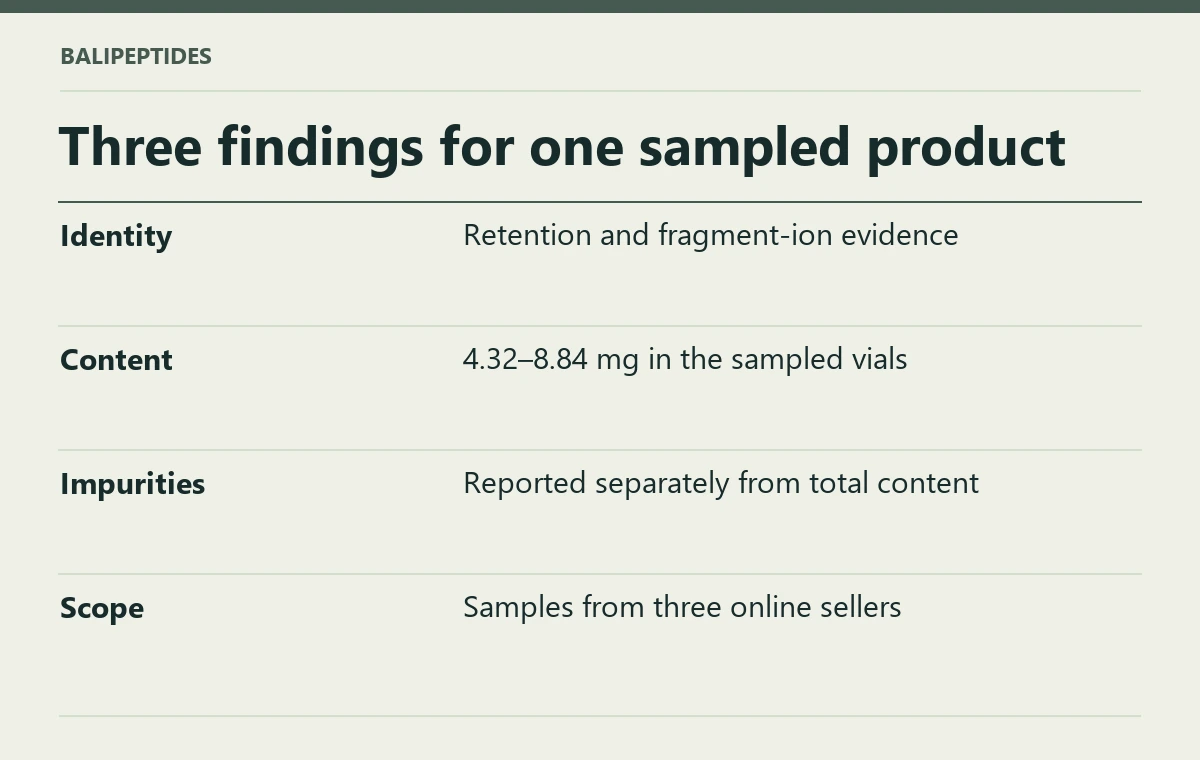
A laboratory can identify Melanotan II in a vial and still find a different amount from the figure printed on its label. Researchers demonstrated that distinction when they investigated products obtained from three online sellers. The results apply to the samples they examined. A different lot or a pen offered in a Bali catalogue needs its own evidence.
How the researchers identified the molecule
The team used liquid chromatography and tandem mass spectrometry. Chromatography provided a retention time. The researchers also compared the relative signals of five selected fragment ions after fragmentation in a mass spectrometer. Together those observations supported identifying Melanotan II in the tested material. The number of milligrams per vial was a separate analytical question. For that calculation the researchers used a method with ultraviolet detection and evaluated its performance. Original analytical study
A report stating that the target molecule was present may therefore be accurate while remaining silent on the amount. Conversely, estimating a mass from a signal depends on the specificity, calibration and preparation used. The complementary methods in this investigation served distinct purposes.
What the sampled vials actually contained
The three sampled sellers each claimed 10 mg per vial. Measured amounts reported in the paper ranged from 4.32 to 8.84 mg. The investigators also found unknown impurities in samples from two shops. For samples from another shop, the impurity result was below the method's quantification limit. Calling an impurity unknown does not establish its chemical identity or its effect in a person.
A small set of samples from an earlier investigation cannot tell us how frequently a mismatch occurs in another market. Keep the product format and the sample source with the numbers. If a claim mentions a high percentage, ask whether it describes relative detector signal, a quantified impurity or total content. Those are distinct outputs of an analysis.
Checking a document for a Bali pen
The Bali Melanotan II listing describes a 20 mg pen, whereas the paper studied vials advertised as 10 mg. For an actual pen, ask which sample or lot the report covers, how the laboratory confirmed the molecule, which quantitative result it obtained and what limits applied to impurity analysis. A clear photograph can identify the label but cannot establish those laboratory findings. A test report linked to the correct sample can address the questions its method was designed to answer.
