Melanotan II in Bali: Pigmentation Science and the 20 mg Pen
Explore melanotan II’s pigment-signalling research, the early human pilot and the labelled 20 mg pen offered for Bali product enquiries.
Melanotan II attracts interest because it engages melanocortin signalling associated with pigmentation. Its research story is more specific than a general tanning trend: a cyclic peptide designed around alpha-melanocyte-stimulating-hormone activity, investigated through laboratory work and an early human pilot.
For readers comparing melanotan II in Bali, Indonesia, the ingredient and the supplied presentation should both be clear. Our catalogue lists a 20 mg prefilled pen at IDR 2,100,000. The product page identifies the format, while the research helps explain why the molecule became a subject of pigmentation studies.
Pigmentation is a biological endpoint
Pigmentation describes colour associated with pigment in the skin. Researchers can assess changes using visual methods and quantitative reflectance measurements. A study using those methods is asking a defined biological question rather than simply recording whether a photograph looks more sunlit.
That matters when images are used in an article. Lighting, camera settings and editing can alter the apparent colour of skin. A polished before-and-after photograph without a reliable measurement method is a weak substitute for a study endpoint.
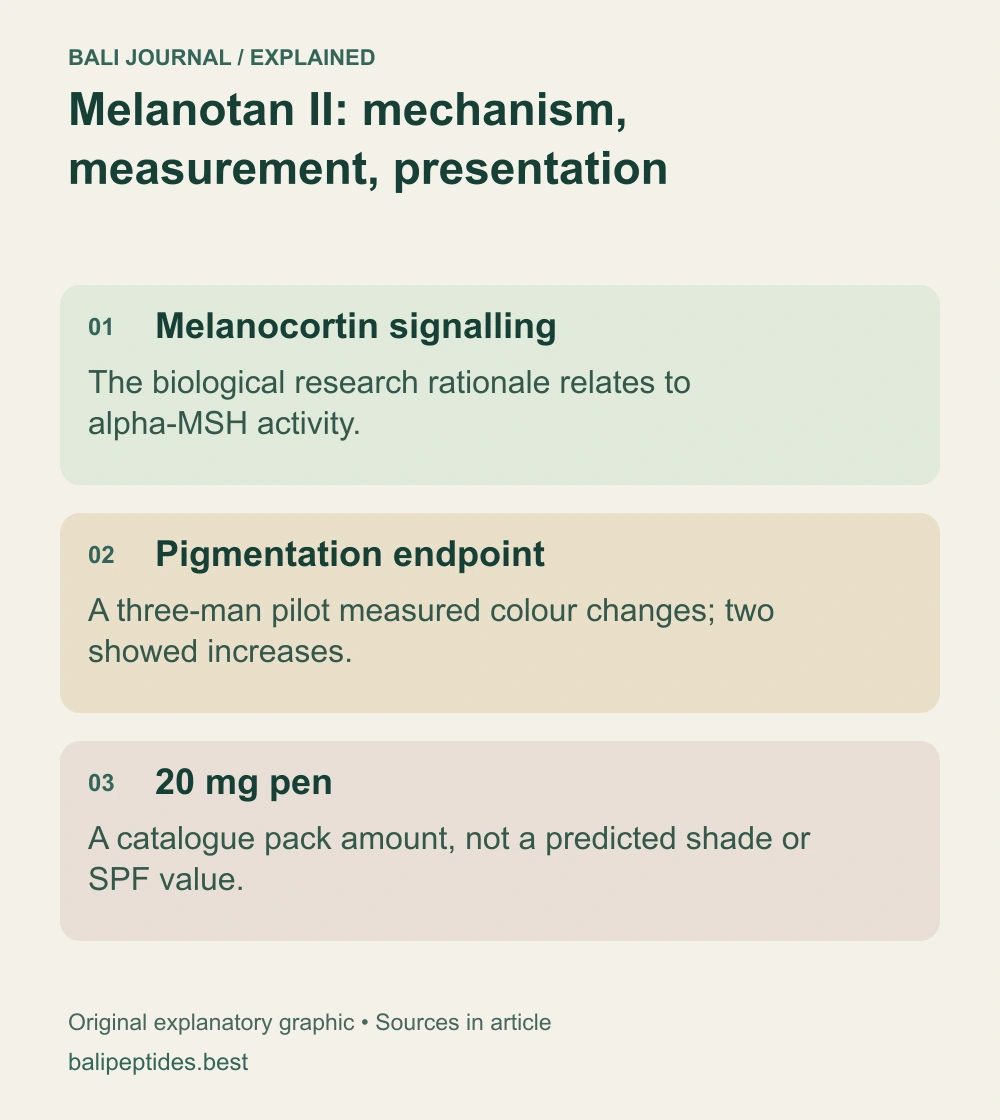
The graphic with this article therefore explains the research sequence rather than showing an invented transformation. It makes the mechanism, measurement and product identity visible as three separate pieces of information.
What the early human pilot found
A phase-I pilot published in 1996 investigated melanotan II in three male volunteers. Two participants showed increased pigmentation measured after the study exposure. The report also described effects including nausea, fatigue or somnolence and spontaneous erections.
The positive finding was a pigmentation signal in that small experimental setting. The sample was too small to establish predictable outcomes for a broad population, and it was not a clinical test of the pen listed in our catalogue.
Keeping the sample size beside the result gives the finding its proper meaning. It is an early human observation that helps explain the scientific interest, rather than a basis for a universal cosmetic promise or a personal administration protocol.
Why the receptor family matters
Melanotan II is an analogue related to alpha-MSH activity. The melanocortin system has functions beyond skin colour, which is one reason the compound's research should not be reduced to a single aesthetic effect.
The non-pigment observations in the pilot reinforce that point. A compound can interact with a biological system in several ways, and a desired colour change is not the whole response profile. A useful discussion includes the observations that matter to the person's question.
This also distinguishes melanotan II from a topical bronzer. A bronzer changes appearance through a cosmetic surface product; the peptide research concerns signalling within a biological pathway. Similar visual vocabulary does not make the two products equivalent.
Pigmentation is not a sunscreen measurement
An increase in skin pigment is not a measured SPF value. The pilot discussed here did not demonstrate protection against skin cancer or establish that sun protection can be reduced. In Bali's outdoor setting, keep UV protection separate from any interest in pigment-signalling research.
That distinction makes the article more useful locally. Time at the beach, a scooter journey and a cafe terrace all create different practical exposure situations, but the research does not supply a personalised safe-exposure timetable for any of them.
If a changing skin lesion or another skin-health concern is the reason for your search, a clinician's assessment is the appropriate next step. Product photographs and an ingredient explainer cannot assess an individual lesion.
The 20 mg catalogue presentation
The melanotan II product page lists the total amount in one prefilled pen. The 20 mg figure is a pack specification, not an individual administration amount or a prediction of a particular shade.
| Detail | What the listing specifies |
|---|---|
| Compound | Melanotan II |
| Presentation | Prefilled pen |
| Total contents | 20 mg |
| Listed item price | IDR 2,100,000 |
| Local enquiry | Bali availability and receiving arrangements confirmed for the request |
Use the name and amount when comparing offers, and review the actual supplied information. A catalogue format can make the item easier to identify; it does not establish that every preparation with the same headline name has been clinically tested.
A clear next step in Bali
For a product enquiry, include “Melanotan II 20 mg pen,” the quantity and your Bali address. If you are staying at a villa in Seminyak, Canggu or Uluwatu, the accommodation name and map pin help identify the receiving location. Availability and timing require confirmation for the actual enquiry.
The most useful way to understand melanotan II is through its defined pigment-signalling mechanism, the small early human observation and the actual pack offered. Review the 20 mg presentation with those three elements in view.
