NAD+ and Cellular Repair: The Science Behind the Interest
Discover how NAD+ connects energy reactions and DNA-repair enzymes, with a clear look at the 1000 mg pen listed for Bali enquiries.
NAD+ attracts attention because it sits at the intersection of cellular energy and enzyme systems involved in repair. It is not a decorative addition to a wellness vocabulary: nicotinamide adenine dinucleotide is a coenzyme used in fundamental cellular processes. Understanding those roles makes the interest in NAD+ much easier to explain.
For readers in Bali, Indonesia comparing NAD+ products, the strongest starting point is the molecule itself, followed by the supplied format. Our catalogue lists a 1000 mg prefilled NAD+ pen at IDR 3,000,000. The listing is a defined product presentation; the research below explains the biological questions that make the ingredient interesting.
Two roles behind one name
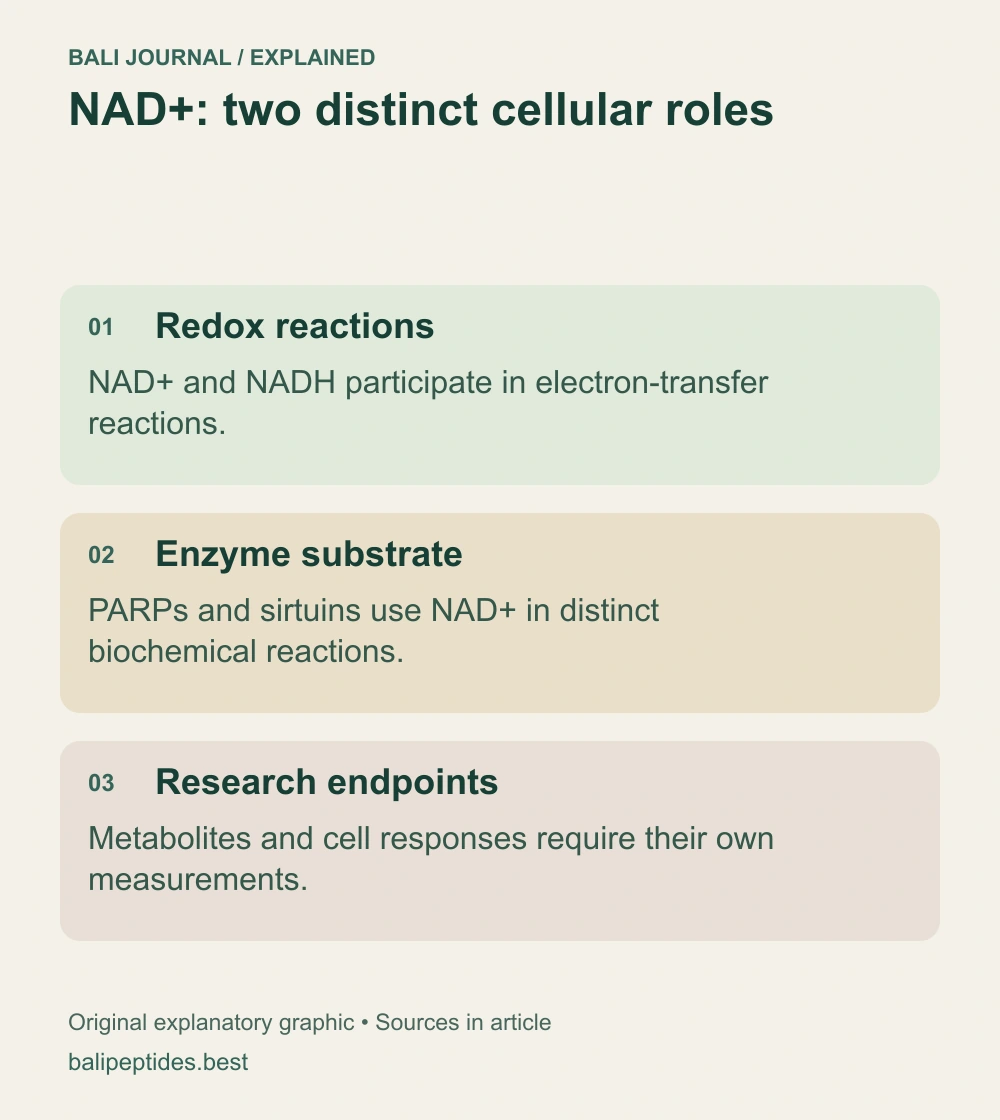
NAD participates in redox reactions through its oxidised and reduced forms, NAD+ and NADH. In those reactions it helps transfer electrons. It also serves as a substrate for enzymes such as PARPs and sirtuins, where the biochemical task differs from electron transfer.
This is why articles connect NAD+ with both energy metabolism and cellular maintenance. The two themes have a real biochemical basis, but they should not be compressed into a promise that a product instantly repairs the body or creates unlimited energy.
NAD+ is a coenzyme, not a peptide. Its appearance beside peptide pens in a catalogue reflects how the products are grouped for browsing, not a change in chemical identity. That simple distinction is useful when comparing ingredient lists and searching for information.
What PARP has to do with DNA repair
PARP enzymes use NAD+ in ADP-ribosylation reactions. These reactions help explain why NAD availability appears in research about cellular responses to DNA damage. A primary molecular study of PARP-1 examined how substrate binding relates to the enzyme's response to damaged DNA.
The important idea is that repair is an organised enzyme-driven process. NAD+ participates in that machinery; it is not itself a replacement set of DNA instructions or a universal correction for every type of damage.
This gives the topic a stronger explanation than the phrase “anti-aging support” alone. You can name the molecule, the enzyme family and the biological process being investigated, without inventing a clinical outcome that the experiment did not test.
What the cell experiments found
Wilk and colleagues studied extracellular NAD+ and PARP-dependent DNA-repair capacity in cultured cells. Their work connects NAD availability with measurable cellular repair-related activity. It is a mechanistic result in a laboratory system, rather than a trial showing rejuvenation or disease treatment with a retail pen.
That distinction does not reduce the scientific interest. Cell experiments help researchers identify the conditions and pathways that deserve further investigation. They tell us what kind of question to ask next, instead of supplying a ready-made claim about every product carrying the same ingredient name.
For readers, a useful habit is to check the experiment's endpoint. A change in enzyme activity, a metabolite concentration and a change in how a person feels are different observations. Clear articles explain which one the evidence actually supports.
Energy metabolism is a separate part of the story
NAD/NADH cycling helps cells handle reactions involved in extracting and transferring energy from nutrients. A biochemical study comparing NAD and related molecules also illustrates why chemical identity matters: related structures do not necessarily perform all the same enzyme-substrate functions.
This makes it worthwhile to distinguish NAD+ from oral precursors such as NR or NMN. A precursor is used in pathways that lead to NAD synthesis; it is not the same supplied substance. Likewise, an NAD+ pen and an intravenous service involve different presentations and routes.
An informed product comparison therefore starts with three questions: what is the molecule, how is it presented and what evidence matches that exact question? The answer should be more specific than a general “cellular energy” label.
Comparing the Bali product presentation
The NAD+ 1000 mg listing gives you a concrete pack to inspect. Its total contents and item price are visible, and its photographs show the presentation offered. Review the product's own supplied instructions and the information applicable to the pack you are enquiring about.
| Comparison point | NAD+ catalogue presentation |
|---|---|
| Ingredient | Nicotinamide adenine dinucleotide, NAD+ |
| Product type | Prefilled pen |
| Total labelled contents | 1000 mg |
| Listed item price | IDR 3,000,000 |
| Local context | Bali product enquiry and confirmed receiving arrangements |
The amount on the pen supports an item-to-item comparison. It is not a statement of how much NAD+ reaches a particular tissue, and it does not translate laboratory repair measurements into a personal outcome.
From reading to a focused enquiry
If you are staying in Bali, include the selected NAD+ format, quantity and receiving address when contacting the team. For villas in Pererenan or Uluwatu, a map pin and an accessible receiving contact can make the location clearer. Availability and timing are confirmed for the actual request.
NAD+'s strongest story is its central place in real biochemistry: electron transfer, enzyme substrates and cellular responses to damage. Use those distinctions to understand the ingredient, then open the current pen details to make a precise, practical Bali enquiry.
