Tesamorelin in Abdominal Obesity: A 12-Month Study Explained
Explore the tesamorelin trial in selected adults with abdominal obesity and low GH secretion, including visceral-fat and lipid measurements.
A detailed discussion of tesamorelin and abdominal fat benefits from looking beyond a single headline. One particularly informative study followed selected adults with abdominal obesity and reduced growth-hormone secretion for 12 months. Its results help explain why tesamorelin is associated with a specific interest in visceral fat rather than simply a lower body weight.
For readers in Bali, Indonesia, the appeal is the precision of that research question. The investigators measured internal abdominal fat and additional metabolic markers in a defined group. Our local product listing answers a separate practical question: the tesamorelin presentation offered for enquiry is a 32 mg prefilled pen.
Who took part in the study?
The randomised, double-blind trial involved 60 adults with abdominal obesity and reduced GH secretion. Participants received the study preparation or placebo, and the researchers followed body-composition and cardiovascular-risk-related measurements over 12 months.
The selection criterion is central to interpretation. This was not an unselected sample of everyone with a larger waist, and it was not a trial specifically in Bali travellers. The result applies to the study's clinical and hormonal context.
That makes the study useful for a more focused conversation. Instead of asking whether a peptide “targets belly fat” in a general sense, you can ask which abdominal compartment changed and which participants were selected for the experiment.
The visceral-fat result in square centimetres
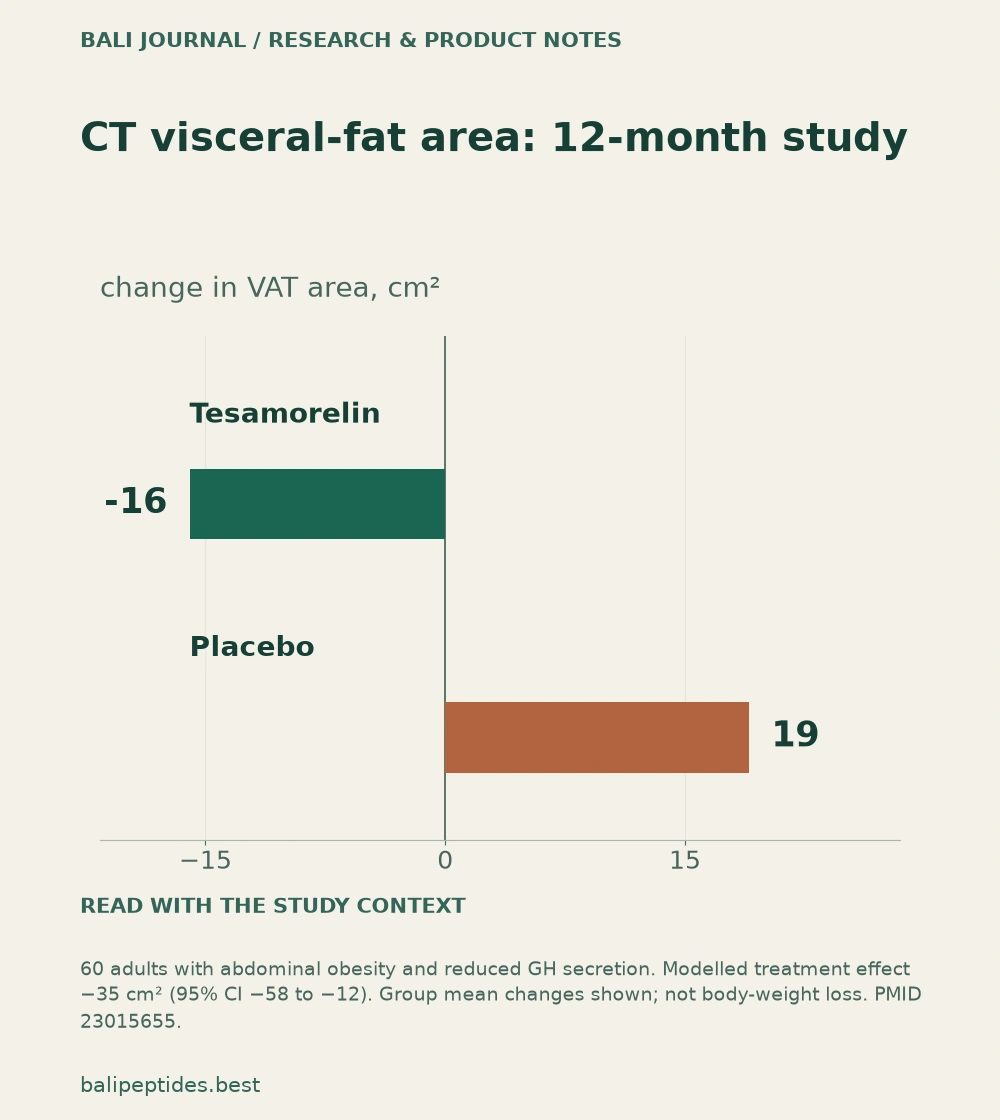
Abdominal CT was used to assess visceral adipose tissue. The study reported mean changes of minus 16 cm² with tesamorelin and plus 19 cm² with placebo, with a modelled treatment effect of minus 35 cm². The treatment-effect confidence interval was minus 58 to minus 12 cm².
Those figures describe an imaging-based area measurement. They are not kilograms of fat, percentage body-weight loss or a measurement of how many centimetres a person's waist shrank. The units give the result its meaning.
The accompanying chart displays the group changes with a zero reference. It makes the direction of the observations easy to see while keeping the endpoint and population visible. It is an original chart of published study values, not a patient transformation image.
Why the subcutaneous-fat finding matters
The same study did not find a significant effect on abdominal subcutaneous fat. This makes the visceral-fat result more specific: the compartments did not simply move together in an identical way.
That distinction is a strength of the research. By separating internal and under-skin abdominal fat, the investigators could ask a more informative question than whether the abdomen looked different in a photograph.
For someone comparing compound research, this is a useful reminder to preserve the endpoint. An imaging result for visceral fat cannot automatically be used as a claim about visible skin tightening, cellulite or every kind of abdominal change.
Metabolic markers added another layer
The investigators also measured triglycerides, inflammatory markers and carotid intima-media thickness. The publication reported improvements in several of those measured endpoints in the tesamorelin group relative to placebo.
These observations broaden the research interest beyond appearance, but they remain measurements within a small selected trial. A change in a risk-related marker is not the same as a demonstrated reduction in heart attacks or another clinical event.
The useful takeaway is the study design: a defined population, an imaging endpoint and several additional metabolic measurements. That combination gives the biological discussion more depth than an isolated before-and-after claim.
How this differs from a weight-loss comparison
Tirzepatide and retatrutide often appear in discussions centred on body-weight change and appetite-related receptor signalling. This tesamorelin study focused on a different pathway and a selected hormonal context. Comparing the largest percentage from unrelated trials would hide those differences.
Start instead with the question you want the evidence to answer. If it concerns visceral fat, look for an imaging-defined VAT endpoint. If it concerns body weight, look for a clearly stated baseline and follow-up weight measurement. If it concerns a personal clinical decision, the relevant history and assessment matter as well.
Tesamorelin 32 mg for a Bali enquiry
The tesamorelin listing identifies 32 mg total contents in one prefilled pen, listed at IDR 2,900,000. The catalogue presentation is not the same thing as the clinical trial preparation, and the total amount is not a personal administration instruction.
Inspect the pack photographs and supplied information, then keep the product name and amount in your enquiry. For a Bali receiving location, include the property name, full address and a map pin where helpful. The team confirms availability and the arrangements for the actual request.
Tesamorelin's abdominal-fat research is strongest when the details remain visible: selected participants, CT-measured visceral fat and a 12-month observation period. Use that evidence to understand the scientific focus, then review the current pen presentation for a clear local product comparison.
