Tesamorelin with exercise in HIV: why chair-stand time is a functional endpoint
A chair-stand test measures how a person performs a defined movement.
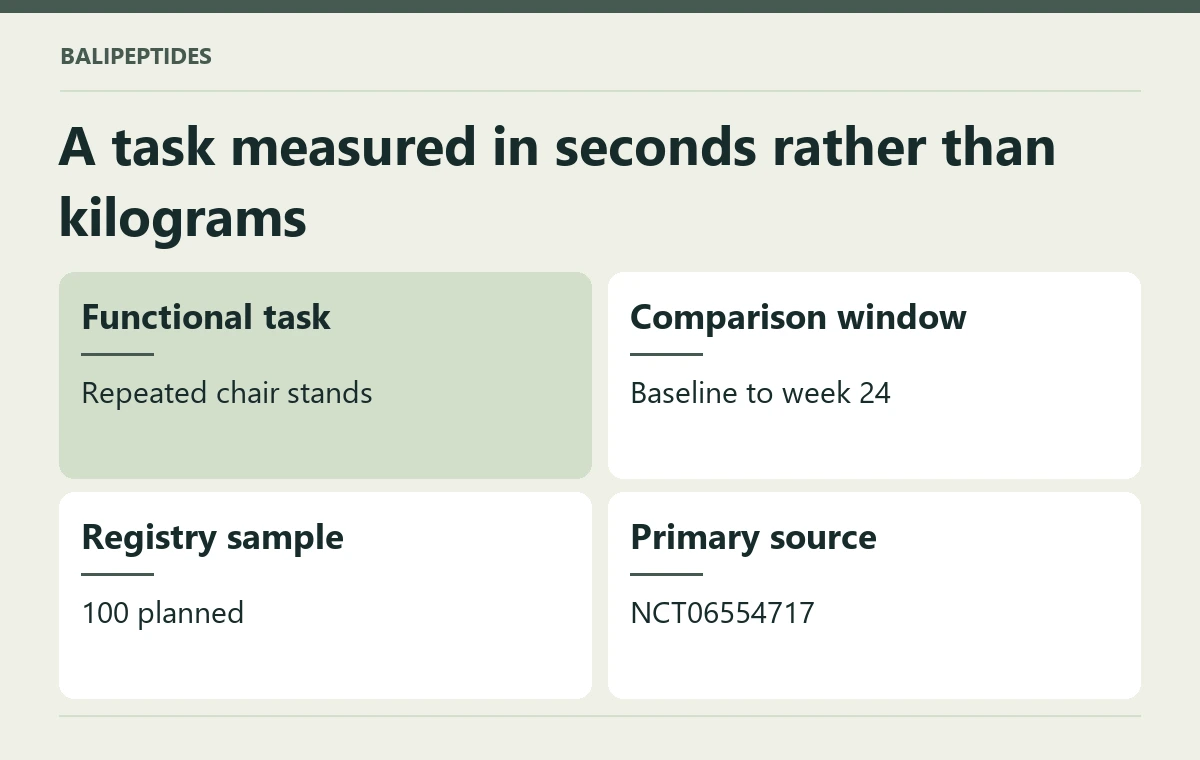
A chair-stand test measures how a person performs a defined movement. It differs from scanning muscle size or recording body weight. A registered study of tesamorelin as an adjunct to exercise in people with HIV uses change in repeated chair-stand time as a primary outcome.
A task measured in seconds rather than kilograms
Two people with similar thigh muscle size can take different times because the task also uses balance, coordination and the ability to move a body through space. Following one standardized test makes that real-world action measurable without pretending it isolates every component. The protocol compares baseline with a defined follow-up. A faster series of chair stands would still need to be distinguished from better endurance during a walk or a change in HIV-related disease status.
Specify what the participant actually did
Repeatedly standing from a chair requires lower-body effort and balance in a defined task. The number of repetitions and the seconds required to complete them mean different things, so retain the unit. If the protocol includes exercise alongside an intervention, also retain that detail before attributing a change in performance to one component.
A chair can appear to be simple equipment, yet its height, instructions about using the arms and the number of repetitions influence the task. To compare before and after, use the protocol's own definitions. A faster time measured with a higher chair or a different allowance for assistance would be harder to interpret as a change in the participant.
Participant and measurement details
- People in the record: 100 (planned enrollment). Eligible ages: 50 years to 80 years.
- Clinical setting: HIV-1-infection, Frailty.
- Named study interventions: Tesamorelin, Placebo, Exercise.
- Study design: phase 2, interventional, randomized, parallel. Masking: quadruple.
- Measured here: Time to complete repeated chair stands.
- Research locations listed in the record include: Aurora, United States and Boston, United States.
- Study calendar in the registration: start 2025-07-10; planned primary completion 2028-06-16.
- Primary record: Massachusetts General Hospital. ClinicalTrials.gov, NCT06554717.
On Bali, a Tesamorelin pen is identified by 32 mg total content. A rehabilitation record instead needs the actual task, assistance permitted and units of time. A clinician can use that detail to decide whether a published functional test resembles a difficulty the patient has at home.
