Tirzepatide and psoriasis: why a two-part response needs both skin and weight measurements
A psoriasis protocol involving ixekizumab and tirzepatide combined two objectives: change in a defined skin assessment and change in body weight.
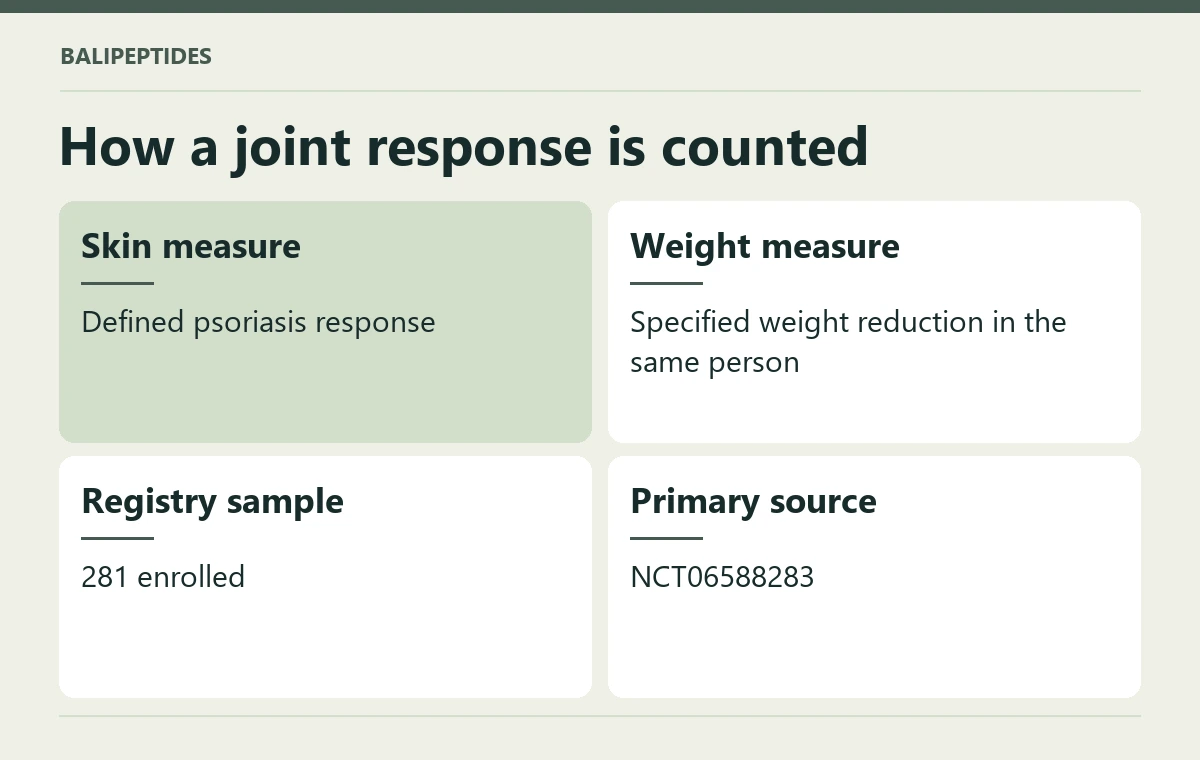
A psoriasis protocol involving ixekizumab and tirzepatide combined two objectives: change in a defined skin assessment and change in body weight. Counting people who met both gives a smaller or equal group than counting everyone who met either one. The combinatorial rule is the main detail to extract from the registration.
How a joint response is counted
Imagine a demonstration group of ten people. Six meet a skin criterion, four meet a weight criterion, and two appear on both lists. The combined response in this invented example is two of ten, rather than four, six or ten. These numbers illustrate the arithmetic only; they are not trial results. The actual protocol defines the skin scale and weight thresholds and includes background dermatologic treatment. A bare statement about tirzepatide and skin improvement would lose both the comparison and the role of the other medicine.
A combined endpoint has its own denominator
Consider four imagined rows for people who meet both target changes, only the skin target, only the weight target, or neither. A rule requiring both counts only the first row. Separate percentages for weight and skin do not tell you how many people fall into that row unless their overlap is also reported.
Reporting the component rates separately would let a reader see whether the combined result was limited primarily by the skin criterion or by the weight criterion. Without those details, two groups might have similar combined rates despite different patterns of individual response. This is a feature of the counting rule, not necessarily a contradiction in the findings.
Participant and measurement details
- People in the record: 281 (actual enrollment). Eligible ages: 18 years and older.
- Clinical setting: Psoriasis, Obesity.
- Named study interventions: Ixekizumab, Tirzepatide.
- Study design: phase 3, interventional, randomized, parallel.
- Measured here: Simultaneous skin and weight responses in the specified population.
- Research locations listed in the record include: Birmingham, United States and Phoenix, United States.
- Study calendar in the registration: start 2024-09-30; primary completion 2026-01-08.
- Primary record: Eli Lilly and Company. ClinicalTrials.gov, NCT06588283.
The local Tirzepatide page provides no psoriasis score and does not identify the dermatological treatment used in the study. A Bali reader comparing skin and metabolic claims should ask for both component results and the treatment background, rather than guessing them from an ingredient name.
